
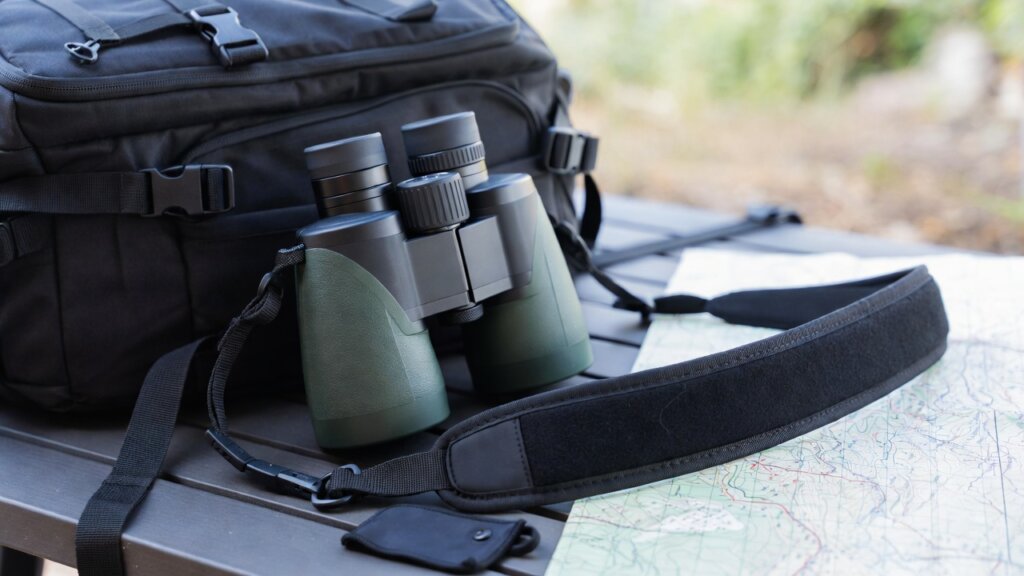
Halfway through a walk, you notice you have been holding your binoculars in one hand for the last twenty minutes. The strap is still attached, but it keeps slipping, pulling at your collar, or letting the binoculars knock against your side.
That is a carrying problem worth fixing.
A binocular shoulder strap moves the load away from the back of your neck and gives you another way to keep your optics within reach. It can work particularly well for sightseeing, relaxed birdwatching, and walks where you stop occasionally to take a closer look.
However, shoulder carry has its own compromises. A soft pad cannot compensate for the wrong length, and a strap that feels comfortable while standing still may behave differently once you start walking.
The right setup lets the binoculars rest comfortably, stay clear of your other gear, and reach your eyes without a tug or a shoulder shrug. Here is how to choose one that does all three.
Is a Binocular Shoulder Strap Right for You?
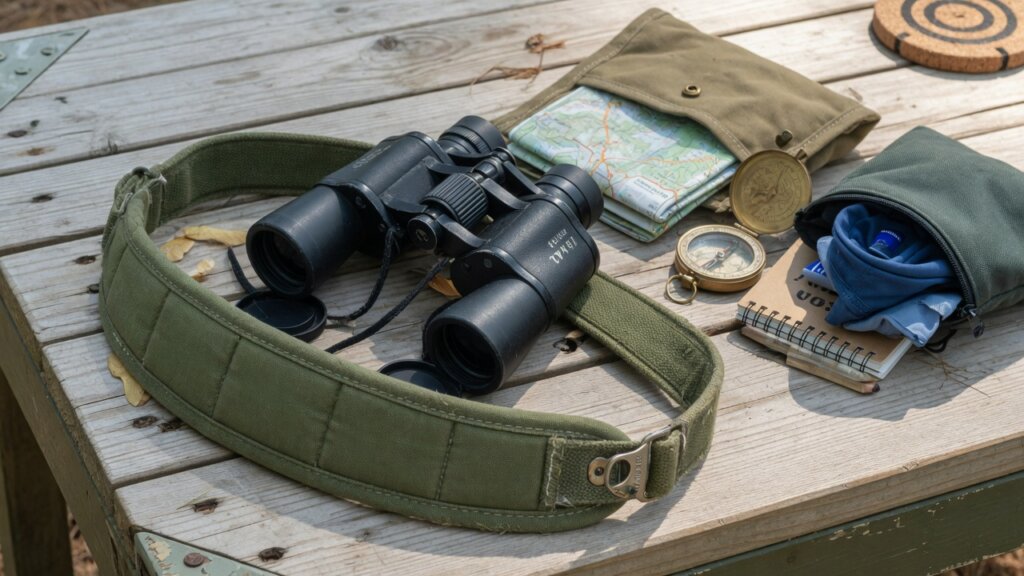
Shoulder carry makes the most sense when your binoculars spend longer being carried than being held to your eyes.
Think of a coastal walk with occasional stops, a sightseeing afternoon, or an easy trail between viewpoints. You want access without keeping the binoculars centered on your chest the entire time.
A binocular shoulder strap is worth considering if:
- Your current neck strap becomes uncomfortable during longer outings.
- You prefer your binoculars resting slightly to one side.
- You use lighter or medium-weight optics for relaxed walking.
- You want a relatively simple carrying setup with little bulk.
It becomes less appealing when you frequently bend, climb, or move through dense vegetation. Binoculars hanging at your side can swing forward or catch on obstacles.
For those outings, compare the alternatives in our binocular strap overview before choosing a particular design.
The important question is how you actually spend your time outside. A strap for a two-hour sightseeing walk does not need to solve the same problems as a carrying system for a steep mountain trail.
Understand the Two Ways to Carry It
“Shoulder strap” can describe two arrangements that feel quite different.
Over one shoulder
The strap rests on one shoulder, with the binoculars hanging on the same side.
This is easy to put on and remove. It can suit short walks between viewing spots, especially when you are not carrying much other equipment.
The drawback is slipping. A smooth jacket, a sloping shoulder, or a forward bend can send the pad toward your upper arm. If you keep lifting your shoulder to hold it in place, that arrangement needs adjusting.
Across your body
The strap passes diagonally from one shoulder toward the opposite hip.
Crossbody carry is generally harder to shrug off accidentally. It can feel more secure while walking, although the binoculars still have room to move.
There is also an important distinction between a long conventional strap and a sliding sling. On a conventional strap, the pad or webbing may move when you raise your optics. A sliding sling allows the equipment to travel along part of the system.
Extra length alone does not turn a fixed strap into a sliding sling. Check the product’s construction before assuming how it works.
Shoulder Strap vs Neck Strap vs Harness
No carrying style wins in every situation. Each puts the binoculars in a different position and handles movement differently.
| Carrying style | Best suited to | Main advantage | Main drawback |
|---|---|---|---|
| Neck strap | Frequent viewing and shorter outings | Binoculars stay centered and easy to reach | Weight rests behind the neck |
| Single-shoulder strap | Occasional viewing and short walks | Simple to put on and remove | Can slide off smooth clothing |
| Crossbody strap | Travel and relaxed walking | More secure against slipping off | Binoculars can swing near the hip |
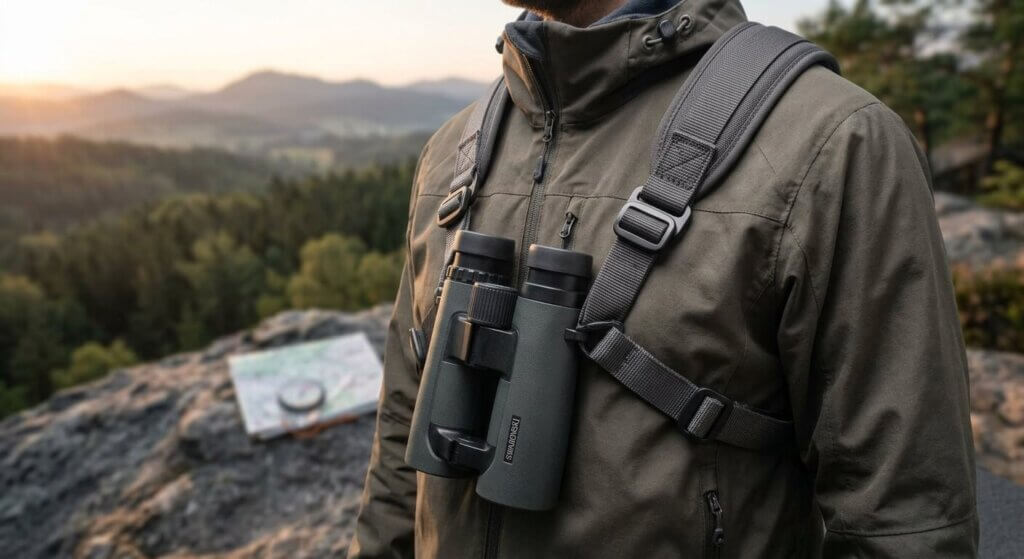
| Harness | Longer walks and more active movement | Distributes weight across both shoulders | More adjustment and additional straps |
If you raise your binoculars every few moments, centered carry may feel more natural. Our binocular neck strap article explains how width, length, and padding affect that option.
If your main frustration is bouncing while climbing, moving the same loose strap onto your shoulder probably will not fix it. A properly adjusted harness deserves a closer look.
For intermittent viewing on easy ground, though, a binocular shoulder strap can offer a useful balance of access and simplicity.
Fit Comes Before Extra Padding 📏
It is tempting to choose the widest, softest strap in the listing. Start with length instead.
A comfortable pad is only useful when it sits where it belongs.
Check the complete carrying length
Hold the binoculars near your preferred resting position. Use a flexible measuring tape to estimate the route between their attachment points and over your chosen shoulder.
Repeat while wearing the jacket you normally take outside.
Then compare that measurement with the product specifications. Check whether the published length includes the connectors; listings do not always describe measurements in the same way.
Leave some adjustment available. A binocular shoulder strap that only fits at full extension may become restrictive over thicker clothing.
Find a resting position that clears your stride
Near the upper hip or lower ribs is a reasonable starting point, but body shape and binocular size will affect the result.
Too low, and the binoculars may strike your thigh. Too high, and bringing them to your eyes may pull the pad inward toward your neck.
Walk around, turn, and sit down before deciding the fit is right. You should be able to reach the binoculars without twisting behind yourself.
Use the actual equipment weight
Do not choose support based only on labels such as 8×42 or 10×50. Binoculars with similar specifications can differ in weight and shape.
Check your model’s weight and consider accessories that stay attached. A large adapter or bulky lens covers can change how the equipment hangs.
For heavier optics, you need to assess both pressure and movement. Better cushioning can soften the contact point while leaving the swinging problem untouched.
Features That Make a Noticeable Difference
A useful binocular shoulder strap does not need a long list of features. It needs the right combination for your clothing, equipment, and walking habits.
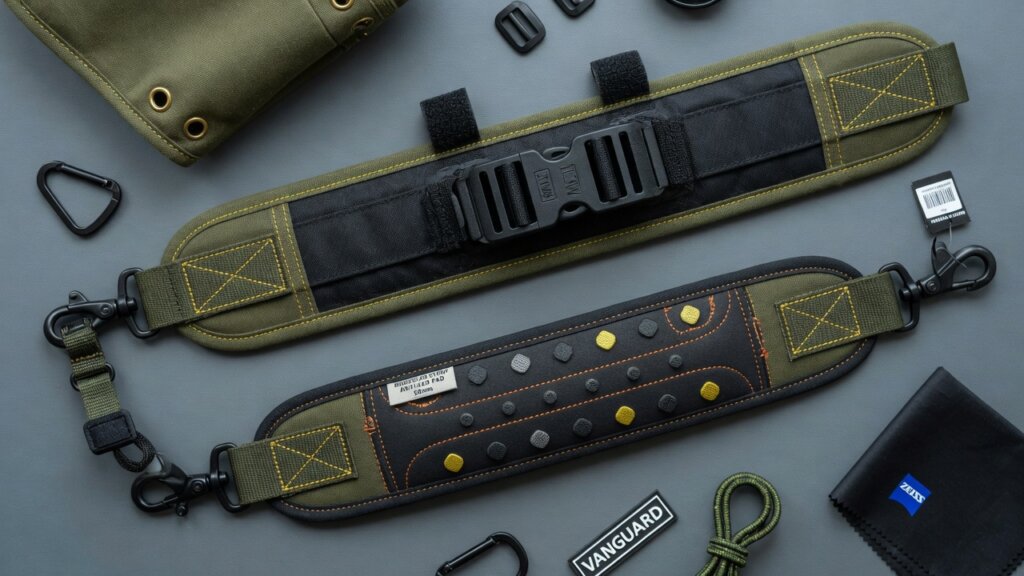
A pad that stays flat
Look for padding that maintains a useful contact area under the binoculars’ weight.
Very soft material may feel pleasant when squeezed but fold into a narrow ridge when loaded. A slightly firmer pad can be more comfortable if it stays flat and has smooth edges.
Our padded binocular strap comparison takes a closer look at cushioning choices for different equipment sizes.
Grip that works with the strap’s movement
A textured underside can help a pad stay on a slippery jacket.
There is a trade-off, however. If the entire strap needs to move as you lift your binoculars, a very grippy pad may pull at your clothing.
That matters more with fixed straps than with systems designed to let the equipment slide independently. Consider how the whole setup moves rather than judging the pad in isolation.
Enough flexibility without excessive bounce
Some stretch can make carrying feel less abrupt. Too much can let heavier binoculars bounce as you walk.
For brisk walking, I would favor controlled support over a very springy feel. For slower outings, softer material may be more appealing.
If you are deciding between flexible and more structured padding, our neoprene binocular strap article explains the practical differences.
Attachment ends that genuinely fit
Check the slots or lugs on your binoculars before ordering.
Webbing should pass through without being forced or tightly folded. Follow the binocular manufacturer’s attachment instructions, particularly if your model uses a proprietary connection.
“Universal” is a description worth checking, not a fit guarantee.
Also consider where the hardware rests. A buckle that repeatedly taps against the binocular body can become irritating even when the connection itself is secure.
One Product Worth Considering
OP/TECH USA Super Classic Strap — Bino 3/8-Inch Version
For conventional shoulder carry, the OP/TECH USA Super Classic Strap in the Bino 3/8-inch version is worth considering.
The manufacturer lists a neoprene pad with non-slip backing, two attachment points, 3/8-inch webbing, and an adjustable length of 23–67 inches. The pad measures 2 × 15 inches. This version does not have quick disconnects, unlike some other Super Classic variants.
Those specifications make it a relevant candidate if you want adjustable shoulder carry and do not regularly detach your strap.
Pros
- Binocular-specific attachment option.
- Broad adjustment range.
- Cushioned pad with a grippy underside.
Cons
- No quick detachment on this version.
- Attachment slots still need checking.
- Fixed construction does not provide sliding-sling movement.
This recommendation is based on the published design and specifications, rather than a hands-on test. Measure your required fit before ordering.
Where Shoulder Carry Works Well 🥾
Birdwatching on easy paths
A binocular shoulder strap for birdwatching suits outings where you walk slowly and stop at promising spots.
Keep the binoculars slightly forward of your hip so they are easy to grasp. If activity becomes frequent, holding them ready for a while may feel easier than repeatedly returning them to your side.
Dense vegetation creates a different challenge. Loose webbing and exposed binoculars have more opportunities to catch. A closer, more contained carrying position becomes useful there.
Sightseeing and travel
Travel favors a setup that feels comfortable around seats, doorways, bags, and crowds.
A lightweight binocular shoulder strap can work well with compact optics. Heavy padding may add bulk without providing much benefit for a small pair.
Before sitting down, bring the binoculars forward and control them with one hand. Check that they cannot become trapped between your body and an armrest.
Crossbody carry can help prevent the strap from slipping off, but you still need to pay attention to exposed equipment in crowded places.
Walking with a backpack
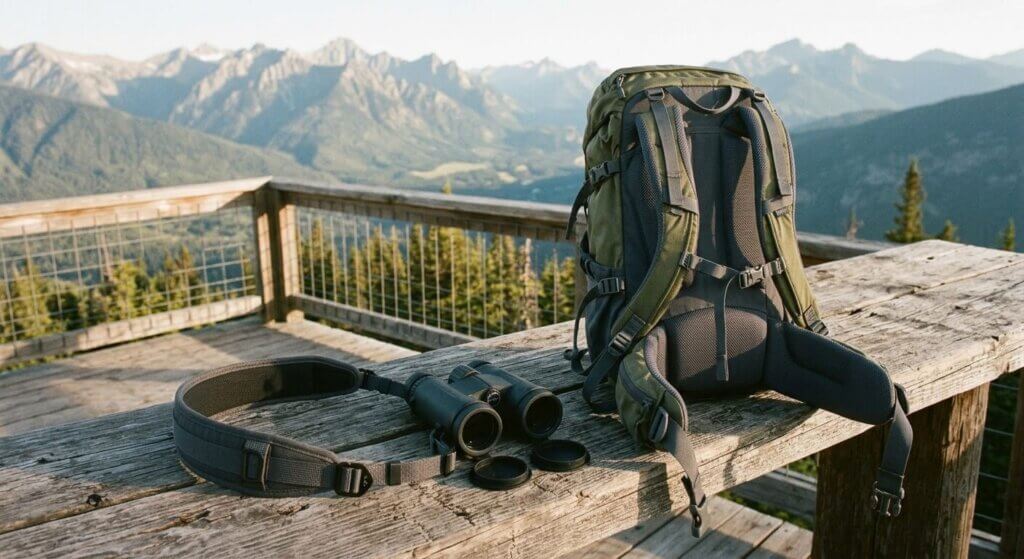
Test your binocular shoulder strap with your backpack loaded as you normally carry it.
Fasten the hip belt and sternum strap, then raise and lower the binoculars several times. Look for trapped webbing, pressure from overlapping pads, and buckles sitting beneath the pack straps.
There is no single layering order that suits every combination.
If the two systems keep interfering, browse our straps and harnesses collection for arrangements that may work better with your pack.
Carrying heavier binoculars
A high load rating does not tell you how comfortable a strap will feel after an hour.
The equipment may be safely supported while placing more pressure on one shoulder than you enjoy. Wider padding can help, but it does not distribute the load across both shoulders.
For long outings with heavy optics, I would compare a harness before spending more on increasingly thick shoulder padding.
Set It Up Before Your First Walk
A short indoor trial can reveal more than another hour spent comparing product photographs.
- Attach both ends correctly. Follow the manufacturer’s routing instructions and required webbing-tail length.
- Check the connections over a soft surface. Support the binoculars while applying gentle tension.
- Adjust the resting height. Start near your upper hip and check clearance.
- Raise the binoculars repeatedly. Watch for twisting or a pad that drags toward your neck.
- Walk, turn, and sit down. Repeat with your usual jacket and bag.
Resist the urge to leave the strap very loose for convenience. Extra length gives the binoculars more room to swing.
Likewise, shortening everything until movement becomes difficult is not the answer. You need enough freedom to view comfortably and enough control for ordinary walking.
💡 A practical check: If you keep holding the binoculars solely to stop them hitting your leg, adjust the carry position before accepting that as normal.
Common Mistakes That Lead to an Uncomfortable Strap
Buying for appearance
A wide pad and chunky hardware can look reassuring. Neither tells you whether the binocular shoulder strap will fit your body or attachment points.
Check the measurements before the styling.
Expecting padding to solve swinging
Padding changes how the load feels against your shoulder. Strap length, carry position, and system design affect how far the binoculars move.
Treat those as separate problems.
Choosing quick-release clips without needing them
Quick-release ends are useful when you regularly remove the strap for storage or change carrying arrangements.
If yours stays attached for months, they may provide little everyday benefit. When you do need them, our quick-release binocular strap article explains the connection details worth comparing.
Skipping a fit trial
Read the seller’s return conditions and keep the packaging while trying the strap indoors.
Use your own binoculars, jacket, and backpack. That combination is what you are buying for.
Forgetting that the optics remain exposed
A binocular shoulder strap provides retention, not protection from every knock, dusty surface, or rain shower.
Use suitable lens covers and a case when needed, especially during transport.
A Final Check Before Buying
| Check | What you want |
|---|---|
| Attachment compatibility | Ends that fit without forced threading |
| Adjustment range | Comfortable fit with some length remaining |
| Viewing movement | Easy lifting without pulling at clothing |
| Walking comfort | Manageable swing and even pad contact |
| Backpack clearance | No trapped webbing or pressure from buckles |
| Storage routine | A setup that fits how you pack your optics |
My buying priority would be compatible attachments, comfortable movement, then cushioning.
That order helps avoid paying for an attractive pad attached to a carrying arrangement that never feels quite right.
Looking After Your Strap
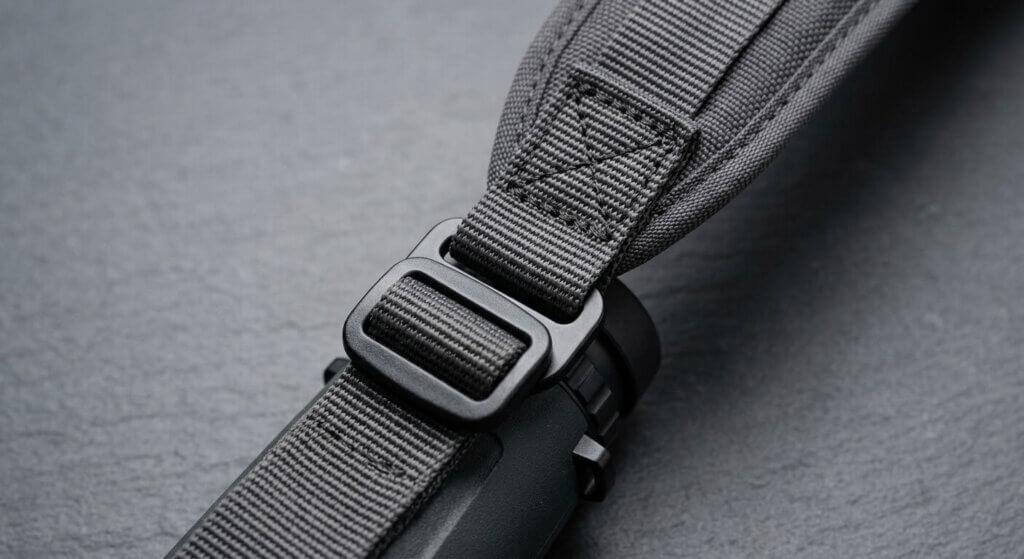
Check the narrow attachment sections periodically, especially where they bend through the binocular lugs. Look for frayed edges, damaged stitching, cracked hardware, or sliders that gradually loosen.
After wet use, follow the manufacturer’s cleaning instructions and allow the strap to dry before packing it away. Fabric coverings and seams may remain damp after the surface feels dry.
Avoid assuming that every strap tolerates machine washing or direct heat.
Keep loose webbing ends secured with the supplied retainers, and replace damaged parts with compatible components.
Frequently Asked Questions
Is a binocular shoulder strap more comfortable than a neck strap?
It can be, particularly if you dislike weight behind your neck. However, it transfers the load to one shoulder. Comfort depends on equipment weight, adjustment, clothing, and how long you carry your binoculars.
Can a binocular shoulder strap be worn across the body?
Yes, if its design and length allow it. Check that you can raise the binoculars without pulling the pad toward your neck. A fixed strap will not move in the same way as a sliding sling.
How do I stop binoculars swinging at my side?
Try shortening the strap slightly and bringing the binoculars closer to the front of your hip. Check that you can still lift them comfortably. If movement remains distracting on active walks, consider a suitable harness.
Can I use a camera strap for binoculars?
Sometimes, provided the attachment system fits and the strap is suitable for the equipment. Check both manufacturers’ instructions. Camera-specific mounting hardware does not necessarily work with binocular attachment points.
What length should I choose?
Measure the carrying route with your binoculars at a comfortable resting height, then check the clearance needed to raise them. Include your usual outerwear and confirm whether the advertised length includes connectors.
Is shoulder carry suitable for all-day outings?
It may suit lighter binoculars and relaxed activity. Heavier optics can become tiring on one shoulder over longer periods. If you repeatedly adjust the strap or develop discomfort, try a more balanced carrying system.
Choose for the Walk You Actually Take
The right binocular shoulder strap should need very little attention once adjusted. Your optics should rest comfortably, come to your eyes easily, and stay clear of your other equipment.
For casual birdwatching and travel, that can be a worthwhile improvement over an uncomfortable factory strap. For heavier loads or demanding terrain, compare a harness before buying.
Explore our binocular blog tips for practical advice on using and caring for your optics. You can also visit Best Binocular to find binocular and accessory comparisons suited to your next outing.




