
The best waterproof binoculars for travel should be easy to carry and comfortable to use when the weather turns. You might start the morning exploring a sunny harbor, spend the afternoon on a windy boat deck, and finish at a misty mountain overlook. A suitable pair needs to handle those changes without taking over your daypack.
The difficulty is choosing how much binocular you really need. A folding pocket model leaves room for your camera and rain jacket. A larger pair can make viewing more comfortable in fading light. The better choice depends on whether you expect a few quick looks between sightseeing stops or long stretches watching distant scenery and wildlife.
For a mixed itinerary, start with the Nikon MONARCH M7 8×30. Consider the ZEISS Terra ED Pocket 8×25 when packed size matters most, or the Nikon MONARCH M5 8×42 when early and late viewing justify extra weight. The Vortex Diamondback HD 8×32 and Pentax AD 8×25 WP offer two other useful approaches: an outdoor-focused midsize option and a compact with generous published eye relief.
The selections below are based on published manufacturer specifications and how those features fit different travel needs. Comfort and handling still deserve a personal fit check before departure.
Affiliate disclosure: We may earn a commission if you buy through links on this page, at no additional cost to you.
Best Waterproof Binoculars for Travel at a Glance
If you want a quick starting point, compare the models below by size, field of view, and glasses clearance. Think about where the binocular will sit in your everyday travel bag, not just whether it fits in your suitcase.
| Model | Recommended travel role | Weight | Field of view at 1,000 yards | Published eye relief | Main compromise |
|---|---|---|---|---|---|
| Nikon MONARCH M7 8×30 | Mixed sightseeing and nature trips | 16.4 oz / 465 g | 435 ft | 15.1 mm | Check fit carefully with glasses |
| Vortex Diamondback HD 8×32 | Hiking and outdoor itineraries | 15.9 oz / about 451 g | 426 ft | 16 mm | Bigger packed footprint than folding compacts |
| ZEISS Terra ED Pocket 8×25 | Carry-on and pocket-focused travel | 10.9 oz / 310 g | 357 ft | 16 mm | Less suitable for sustained dim-light viewing |
| Pentax AD 8×25 WP | Compact travel with glasses | 10.6 oz / 300 g | 288 ft | 21 mm | Narrower field of view |
| Nikon MONARCH M5 8×42 | Dawn outings and wildlife-focused trips | 22.2 oz / about 629 g | 335 ft | 19.5 mm | Noticeably heavier than pocket models |
Specifications are manufacturer-listed; conversions are rounded. The use-case recommendations are editorial judgments, not measured performance rankings. Accessories add carrying weight.
For daylight sightseeing, carrying convenience can matter more than larger lenses. For early excursions, the extra weight of an 8×42 may be worth accepting. That is the most useful decision to make before comparing prices.
What Does Waterproof Mean for Travel Binoculars?
Waterproofing and Fog Resistance Are Different Features
Waterproof construction protects the binocular’s interior against water ingress under specified conditions. Gas filling helps resist internal condensation. A water-repellent coating on exposed glass helps manage droplets on the surface. One feature does not substitute for the others.
This distinction matters on a wet excursion. Your binocular can remain dry inside while raindrops blur the outside view. Likewise, an intact nitrogen-filled body does not prevent your breath from misting a cold eyepiece. Nikon describes its sealed, nitrogen-filled construction as protection for the internal optical system, not permission to use binoculars underwater.
Check the exact model’s specifications rather than assuming that every binocular in the same brand or range has identical protection.
Check the Manufacturer’s Waterproof Rating
Nikon specifies the MONARCH M7’s waterproofing at up to one meter for ten minutes and explicitly excludes underwater use. Pentax lists one-meter waterproofing for the AD 8×25 WP. ZEISS publishes a 100 mbar water-resistance specification for the Terra ED Pocket. These are differently expressed specifications, not interchangeable promises.
Vortex describes the Diamondback HD as O-ring sealed, argon-purged, and waterproof. Its product page does not provide an equivalent immersion depth and duration, so assigning it one would be guesswork.
For ordinary travel, the aim is to keep using your binoculars through a shower or an unexpected splash. You should still put them away when they are not needed, especially on an exposed boat deck. Waterproofing reduces the consequences of wet conditions; sensible handling reduces the exposure in the first place.

The Best Waterproof Binoculars for Travel: Our Recommendations
1. Nikon MONARCH M7 8×30 — Best Overall Balance for Mixed Travel
The MONARCH M7 8×30 is a strong starting point for a trip that mixes waterfront walks, mountain viewpoints, and occasional wildlife stops. Its 435-foot field of view at 1,000 yards gives you more room to find a subject than several smaller alternatives, without moving up to a full-size body.
It combines ED glass, a locking diopter, and water- and oil-repellent coatings on the objective lenses and eyepieces. Those are useful features for equipment repeatedly handled and packed throughout a trip.
Pros: Wide view, manageable travel weight, and a practical balance between portability and viewing ease.
Cons: Not a true folding pocket model. The 15.1 mm published eye relief makes an actual glasses-on fit check important.
Choose it for: A trip where binoculars will come out several times daily, but will not be the largest item in your bag.
If you are deciding between Nikon ranges, our comparison of the best Nikon binoculars can help you narrow the options around the viewing you actually plan to do.
2. Vortex Diamondback HD 8×32 — Best Fit for Hiking-Focused Travel
The Diamondback HD 8×32 makes sense when most days involve trails and outdoor stops. Its 426-foot field of view at 1,000 yards, rubber armor, and tripod compatibility form a practical combination for a binocular that spends considerable time outside its case.
The main buying decision is how it compares with the M7 at the price available to you. If both fit comfortably, consider the package, seller, and price difference before deciding. Neither needs to be the automatic choice simply because you already recognize the brand.
Pros: Broad view, outdoor-oriented handling, and a useful midsize format.
Cons: Less packable than a folding 25 mm model; the published waterproof claim lacks a specific immersion limit on the product page.
Choose it for: Walking holidays where you have room for a dedicated binocular compartment.
If your travel includes regular hiking, compare the best Vortex binoculars for your outdoor plans before settling on a size.
3. ZEISS Terra ED Pocket 8×25 — Best for Packing Light
The Terra ED Pocket 8×25 makes sense when a larger binocular would spend too much of the holiday in your accommodation. At 310 g, with a folding design, it suits the traveler choosing between a small pair and leaving binoculars behind. ZEISS lists nitrogen filling and a waterproof body.
Its 357-foot field of view at 1,000 yards is also wider than the Pentax compact’s published figure. That gives it a useful advantage when you want a little more scene around the subject, although fit remains personal.
Pros: Low weight, compact folding design, and a relatively generous view for this comparison’s pocket category.
Cons: Small objectives impose a dim-light compromise; compact controls deserve a handling check if you wear gloves.
Choose it for: Daylight sightseeing, light luggage, and spontaneous stops on trips where observation is a bonus rather than the main activity.
For a trip with strict luggage limits, our selection of the best compact binoculars for travel puts more emphasis on models that are easy to take along each day.
4. Pentax AD 8×25 WP — Best Compact Candidate for Glasses Wearers
The Pentax AD 8×25 WP deserves attention for its 21 mm published eye relief. That is a promising starting point if glasses keep your eyes farther from the eyepieces, though it does not guarantee a perfect fit.
The compromise is a narrower view: 288 feet at 1,000 yards. Its 300 g body favors carrying convenience over panoramic scanning. These specifications make it a sensible compact to try, especially if other small binoculars cut off the edges of your view.
Pros: Light weight, long stated eye relief, and waterproof construction.
Cons: Narrower field and less dim-light flexibility than larger formats.
Choose it for: Deliberate sightseeing from overlooks, waterfronts, and other stops where you have time to locate the subject.
5. Nikon MONARCH M5 8×42 — Best for Wildlife Trips With Dim-Light Viewing
The MONARCH M5 8×42 is the pair to consider when early starts and evening outings are an important part of the holiday. Its 42 mm objectives and approximately 5.3 mm exit pupil give it more scope for dim-light viewing than the pocket formats, assuming comparable optical quality. Its 19.5 mm eye relief also merits attention from glasses wearers.
Nikon lists ED glass, waterproof and fogproof construction, and a weight of 22.2 ounces. The tradeoff is a 335-foot field of view at 1,000 yards, narrower than the two midsize models above.
Pros: Larger exit pupil, generous stated eye relief, and a format suited to sustained observation.
Cons: More carrying weight and space; not the widest view in this selection.
Choose it for: Wildlife-focused vacations where binoculars deserve a permanent place near the top of your bag.
8×25 vs. 8×32 vs. 8×42: Which Size Travels Best?
The numbers on a binocular tell you its magnification and objective lens diameter. In 8×32, for example, 8× is the magnification and 32 mm is the diameter of the front lenses. The three formats below offer the same magnification, but differ in carrying size and the light beam delivered to your eyes.
8×25: Best When Packing Space Comes First
Pick this format when space is tight and most viewing happens in daylight. It is particularly appealing for a small crossbody bag or a daypack already occupied by camera gear.
The limitation is not simply that the front lenses look small. An 8×25 produces a 3.125 mm exit pupil: the objective diameter divided by magnification. That smaller beam gives your eyes less positioning tolerance than a larger exit pupil. In dim conditions, it can also limit brightness when your pupils have expanded beyond it.
If you prefer Nikon and want a smaller alternative to its full-size models, compare compact Nikon binoculars for travel before deciding how much space to reserve in your bag.
8×30–32: A Useful Balance for Mixed Trips
This is where I would begin for a mixed itinerary. You accept more bulk than a pocket model in exchange for a larger exit pupil and, depending on the model, a wider view.
An 8×32 produces a 4 mm exit pupil. That does not make every 8×32 optically superior to every 8×25, but it explains why the midsize format is worth considering for repeated viewing rather than occasional glimpses.
8×42: Worth the Space for Early and Late Viewing
An 8×42 produces a 5.25 mm exit pupil. The extra capacity becomes useful when ambient light falls and your eyes can accept that wider beam; it is not a promise of a dramatically brighter image at noon.
Lens coatings, transmission, glare control, and your own vision still affect the result. Bigger objectives also mean little if the binocular stays in the hotel because you dislike carrying it.
| Travel pattern | Format to shortlist first | Reason |
|---|---|---|
| Daylight city breaks with minimal luggage | 8×25 | Low weight and small packed size |
| Mixed sightseeing and nature walks | 8×30 or 8×32 | Balanced portability and viewing flexibility |
| Dawn outings and shaded wildlife viewing | 8×42 | Larger exit pupil for dim conditions |
| Casual shore excursions | 8×25 or 8×32 | Easy carrying between stops |
| Long observation sessions from a lodge | 8×42 | Carrying bulk is less restrictive |
If you want to keep using the same pair for local walks and weekend outings, compare binoculars for general use alongside these travel-focused choices.
Why 8× Usually Makes More Sense Than 10× for Travel
Moving from 8× to 10× increases apparent subject size by 25%, which sounds appealing when your subject is far away. The tradeoff is that it also magnifies hand movement more strongly.
Picture a windy overlook after a long climb. You are breathing harder than usual, your arms are tired, and there is nowhere comfortable to brace. Extra magnification may enlarge the scene without helping you study it more easily.
Ten-power binoculars still have a place. They can suit distant architectural details or open-country viewing when you have steady support. But for mixed handheld travel, I would prioritize an easy, stable view over additional reach.
For that reason, the recommendations here focus on 8× models. They are a sensible starting point for the quick, handheld viewing that makes up much of a typical holiday.
Comfort Features to Check Before You Buy
Eye Relief Must Work With Your Glasses
Eye relief describes the distance behind the eyepiece where your eye can see the intended field. Glasses add separation, which can make part of the view disappear when usable eye relief is insufficient.
Published figures help you shortlist, but eyecup shape, lens recess, and your frames affect the result. Try your actual travel glasses or sunglasses. If you have to press hard against the eyepieces, keep comparing.
Field of View Helps You Find What You Came to See
A wider field shows more of the scene without moving the binocular. That can make it easier to locate a subject and follow movement. Compare linear field-of-view figures at the same distance; feet at 1,000 yards and meters at 1,000 meters are different measurements.
There is also a travel benefit beyond wildlife: a broad view gives surrounding context when you are trying to locate one balcony, distant lookout, or opening in a cliff face.
Handling Is Personal, So Check It Before Departure
Consider the sequence you will repeat: remove the binocular, unfold it if necessary, position the eyecups, find the scene, and focus. Any awkward step becomes more noticeable when the stop lasts only a minute.
A useful pre-trip check is to alternate between a distant building and something closer. Repeat with your usual glasses. Check whether the focus wheel falls naturally under your finger and whether the hinge holds your preferred spacing. A specification table cannot settle those questions.
Matching Waterproof Travel Binoculars to Your Itinerary 🧳
Cruises and Coastal Excursions
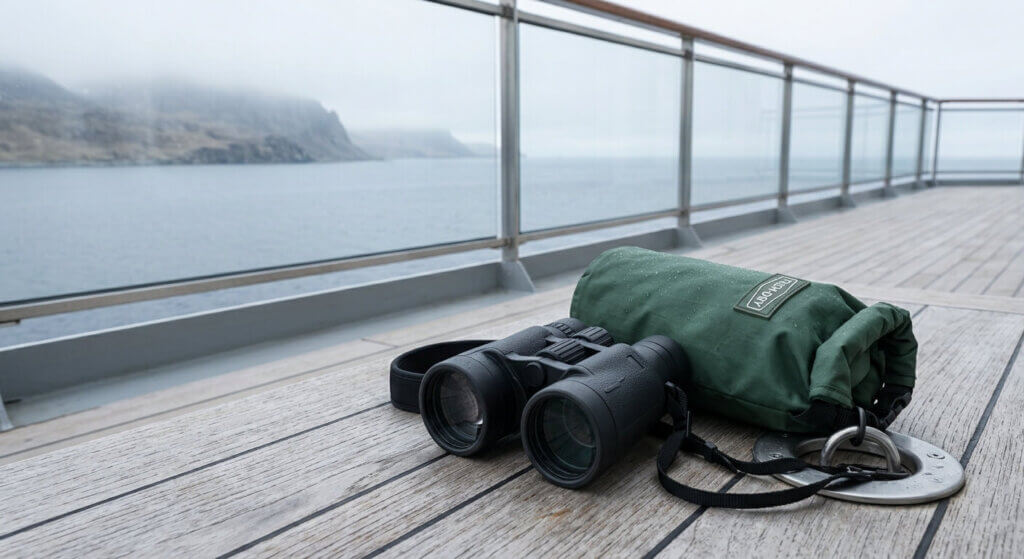
For casual deck viewing and shore stops, I would begin with a midsize 8× model. Keep it accessible, but secured. Binoculars that are waterproof do not necessarily float, and an ordinary neck strap does not provide flotation.
If the itinerary involves small boats or repeated spray exposure, carrying protection deserves as much attention as the binocular itself. A closed dry bag protects equipment between viewing opportunities. Keep the case or dry bag within easy reach so you can put the binoculars away between stops.
Wet Hiking Holidays
On a walking trip, packing location can determine whether the binocular gets used. Bury it below lunch and a rain shell, and every brief stop becomes a rummaging exercise.
For frequent viewing, the M7 or Diamondback formats are reasonable starting points. For occasional scenic pauses, a pocket model may be the better compromise. On a long walking day, a pair you can carry comfortably is more useful than one you keep finding reasons to leave behind.
Wildlife-Focused Vacations
Let the schedule decide. If excursions begin before sunrise or continue into fading light, place more weight on the 8×42 option. If most outings happen in good daylight and walking distances are substantial, consider a midsize model instead.
Also decide whether two travelers will share. Passing one binocular back and forth can mean repeated changes to focus, spacing, and eyecups. If you plan to share, try those adjustments together before the trip. That helps you judge whether one pair will be convenient enough for both people.
City Breaks and Scenic Road Trips
Pocket binoculars make particular sense for distant facades, mountain roads, harbor views, and observation decks. These are often short viewing sessions in adequate light.
An 8×25 that fits your everyday bag can be entirely adequate for these outings. There is little reason to carry a larger pair solely for a low-light excursion you are unlikely to take.
How Much Should You Spend?
A useful budget begins with frequency. Someone taking one scenic vacation has different reasons to upgrade than someone who travels monthly and uses binoculars on every outing.
Compare current prices for the exact model and magnification. Similar names can hide different objective sizes, older versions, or different packages. A lower advertised price is less attractive if the seller’s returns are awkward or the included accessories differ from what you expected.
Working with a firm budget? Our comparison of the best binoculars under $200 for travel is a useful next stop. Check the current price and waterproof specification of the exact model, since discounts and availability can change.
An upgrade is easier to justify when it solves a specific problem: uncomfortable glasses clearance, excessive weight, a restricted view, or difficulty observing in dim light. If the more affordable pair already fits your needs, you do not have to move up a range.
Leave room in the budget for a suitable case or strap if the supplied accessories do not suit how you plan to carry the binoculars.
Travel Accessories That Are Worth the Space
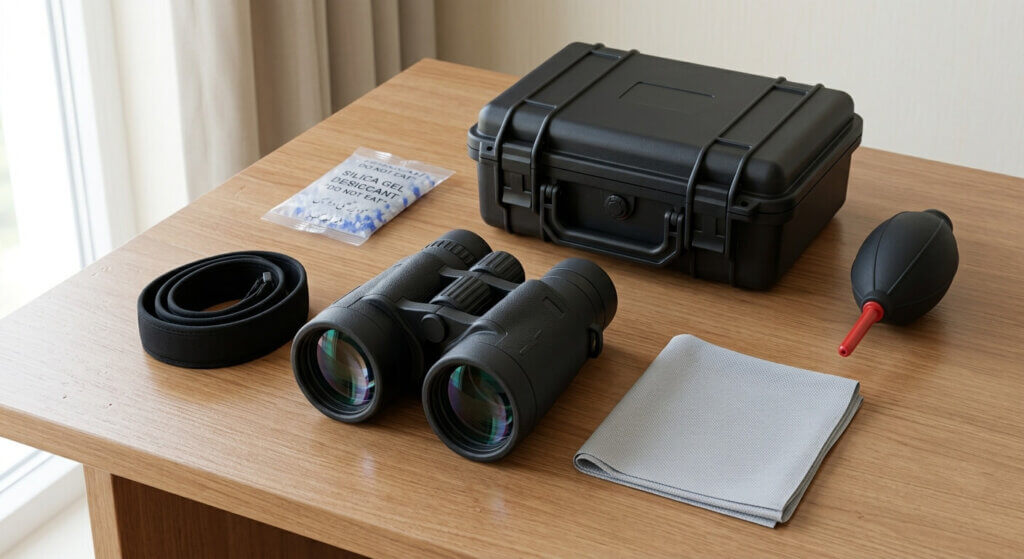
A well-fitting case, secure strap, eyepiece cover, and clean lens cloth cover most ordinary trips. Add a small lens-safe blower or brush for loose grit. Keep cleaning materials somewhere they will not collect sand themselves.
A tripod is worthwhile when your plans include sustained viewing from a fixed position. For quick handheld sightseeing, it can become another item to carry and set up. Check binocular compatibility before buying a mount: folding compacts do not all accept standard adapters.
For longer sessions from a balcony or fixed lookout, compare compact binocular adapters for a steadier setup. Confirm the mounting method and clearance for your specific binocular before ordering.
Pack the accessories you will actually use. For most sightseeing, keeping the binocular secure, accessible, and protected between stops is more valuable than carrying a large collection of mounts.
Keeping the View Clear in Rain and Changing Temperatures 🌧️
Waterproof binoculars still need routine care. Wipe moisture from the body, remove loose dust before cleaning glass, and dry equipment before putting it into a closed case. Avoid strong heat and follow the manufacturer’s cleaning instructions. After saltwater exposure, follow the model’s specific exterior-cleaning guidance promptly.
External fogging is a separate issue. Cold lenses can collect condensation when they meet warmer, humid air. On a trip, that might happen when you leave an air-conditioned vehicle for a humid waterfront or bring chilled equipment into a warm room.
Allow time for adjustment rather than repeatedly rubbing the lenses. Keep your breath away from cold eyepieces. If haze appears inside a sealed binocular and persists, contact the manufacturer instead of opening the housing yourself.
Common Buying Mistakes That Lead to Regret
Choosing maximum magnification first. A larger-looking subject is not automatically easier to inspect when the view shakes.
Buying a pocket model for a mostly twilight itinerary. Compactness is valuable, but it comes with a tradeoff. Be honest about when your viewing will happen.
Treating waterproof and floating as the same claim. They are different capabilities. Never assume either from a product photograph.
Ignoring the full carrying package. Compare binocular, case, strap, and any mount together. The weight in your luggage is what matters.
Waiting until departure to check fit. Give yourself time to discover whether the eyecups, spacing, and glasses clearance work for you.
If none of these formats feels right, our broader comparison of the best binoculars for different viewing needs can help you explore other options.
FAQs About the Best Waterproof Binoculars for Travel
What Are the Best Waterproof Binoculars for Travel Overall?
The Nikon MONARCH M7 8×30 is this article’s overall recommendation for mixed travel. Its combination of moderate weight and broad field of view suits varied outings. Choose a pocket model if carrying size matters more, or an 8×42 if dim-light observation is central to the trip.
Are 8×25 Binoculars Good for Travel?
Yes. Waterproof 8×25 binoculars suit daylight sightseeing and light packing. Their main compromise is a smaller exit pupil, which makes them less flexible for dim conditions and eye positioning than comparable larger formats.
Are 8× or 10× Binoculars Better for Travel?
Eight-power binoculars are the stronger starting point for general handheld travel because they magnify hand movement less. Ten-power models can suit distant subjects when you can hold them steadily or use support.
Do Waterproof Binoculars Also Prevent Fogging?
Not necessarily. Waterproofing addresses water ingress, while dry-gas filling helps resist internal condensation. Even a waterproof, fog-resistant binocular can develop condensation on its exposed outer lenses.
Which Compact Waterproof Binoculars Suit Glasses Wearers?
The Pentax AD 8×25 WP is worth trying because of its generous published eye relief. However, glasses shape and eyecup design affect the usable view. Check the binocular with your own frames before deciding.
Can Waterproof Binoculars Be Used Underwater?
Do not assume so. The travel models discussed here are intended for above-water observation. Follow the specific manufacturer’s limits; an immersion-resistance claim is not a recommendation for underwater viewing.
Is an 8×42 Too Large for Travel?
Not if binocular viewing is a major part of the trip. It becomes less appealing when you need minimal luggage or only expect occasional daytime use. Judge the size alongside the rest of your daily carrying load.
Do I Need a Tripod for Travel Binoculars?
Usually not for brief handheld viewing with 8× binoculars. A tripod can help during longer sessions from a fixed location, but adds bulk. Confirm mounting compatibility before buying an adapter.
Which Waterproof Travel Binocular Should You Choose?
For mixed travel, start by trying the Nikon MONARCH M7 8×30. Compare the Vortex Diamondback HD 8×32 if your itinerary leans toward hiking. Shortlist the ZEISS Terra ED Pocket 8×25 for packing convenience and the Pentax AD 8×25 WP when compactness and glasses clearance both matter. Choose the Nikon MONARCH M5 8×42 when observation in dim light deserves more space in your bag.
Before buying, check the current price, exact model, fit, and return policy. Then imagine carrying that pair through a full day of your planned trip. If its size feels manageable and its strengths match the way you will use it, you have a much better reason to choose it than a long feature list alone.
🔭 Planning your next outing? Explore BestBinocular.net for binocular comparisons and practical care advice to help you choose confidently and keep your equipment ready for the journey.




