
Roof Prism vs Porro Prism for Beginners: Which One Should You Choose?
Buying your first serious binocular sounds simple until you run into one confusing question:
Should beginners choose roof prism or porro prism binoculars?
At first, both look like normal binoculars. They both magnify distant objects. They both come in popular sizes like 8×42, 10×42, 7×35, and 10×50. But once you actually hold them, focus them, carry them, and compare the view, the difference becomes obvious.
For beginners, the real answer is not “roof prism is better” or “porro prism is better.” The better choice depends on how you plan to use your binoculars, how much you want to spend, and whether you care more about compact handling or maximum optical value.
This beginner-friendly guide breaks down roof prism vs porro prism for beginners in plain English, based on real-world use, common buying mistakes, and what new users usually notice first.
Quick Answer: Roof Prism vs Porro Prism for Beginners
For most beginners, porro prism binoculars are the better value if you want brighter image quality for less money.
But roof prism binoculars are easier to carry, easier to pack, and usually feel more modern in the hands.
Here is the simple version:
| Beginner Need | Better Choice | Why |
|---|---|---|
| Best image quality for the price | Porro prism | Usually gives a bright, wide, natural view at lower cost |
| Compact design | Roof prism | Slimmer and easier to carry |
| Casual travel or hiking | Roof prism | More portable and often easier to weather-seal |
| Backyard bird watching | Porro prism | Wider depth and more relaxed viewing feel |
| First budget binocular | Porro prism | More optical performance per dollar |
| Premium long-term binocular | Roof prism | Better build quality once you spend more |
| Simple learning experience | Porro prism | Easier to understand image depth and focus behavior |
My honest take: if your budget is low, don’t rush into cheap roof prism binoculars just because they look cleaner. A beginner can often get a better view from a well-made porro prism than from a low-cost roof prism.
That is why this topic matters.
What Is a Roof Prism Binocular?
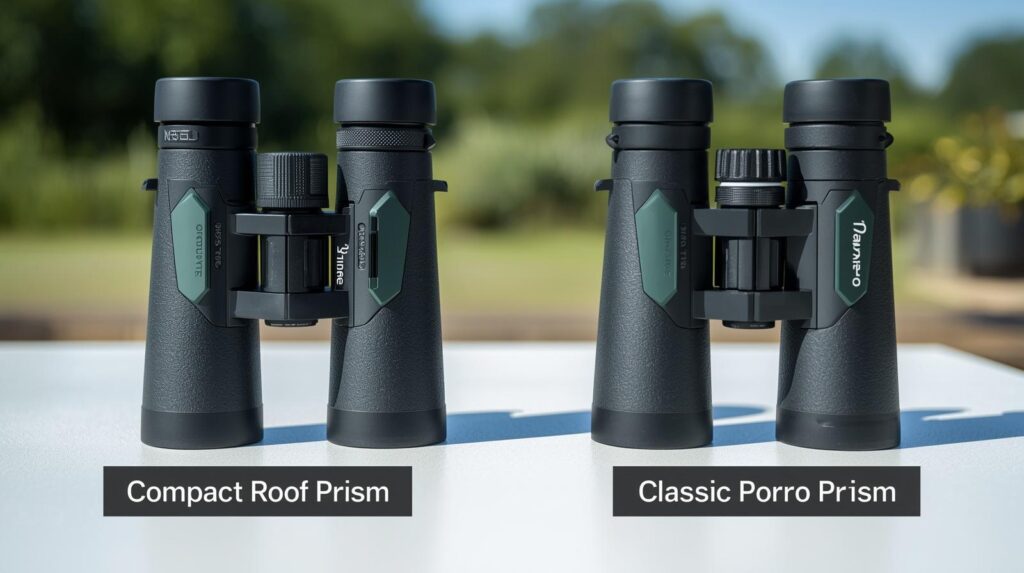
A roof prism binocular has a straight-barrel design. The objective lenses at the front and the eyepieces at the back line up in a slim, straight shape.
This is the design many people think of when they picture modern binoculars.
Roof prism binoculars usually feel:
- Slim
- Compact
- Easy to hold
- Easier to pack
- More modern-looking
- Better for travel and walking around
The catch is that roof prism binoculars are more complex inside. To deliver a sharp, bright image, they need better coatings and more precise alignment. That is why cheap roof prism binoculars can sometimes look dim, flat, or less sharp than expected.
A good roof prism binocular can be excellent. A cheap one can disappoint beginners fast.
What Is a Porro Prism Binocular?
A porro prism binocular has the classic wide-bodied shape. The front lenses sit farther apart than the eyepieces, creating that familiar zigzag-style body.
Porro prism binoculars usually feel:
- Wider in the hands
- A bit bulkier
- Very stable to grip
- Often brighter for the price
- More three-dimensional in viewing feel
- Great for relaxed observation
The main advantage is value. Porro prism binoculars are less complex to produce compared with equivalent roof prism models, so beginners often get better optical performance without paying premium prices.
The downside? They are not as compact. They may be less convenient for travel bags, long hikes, or users who want something small and sleek.
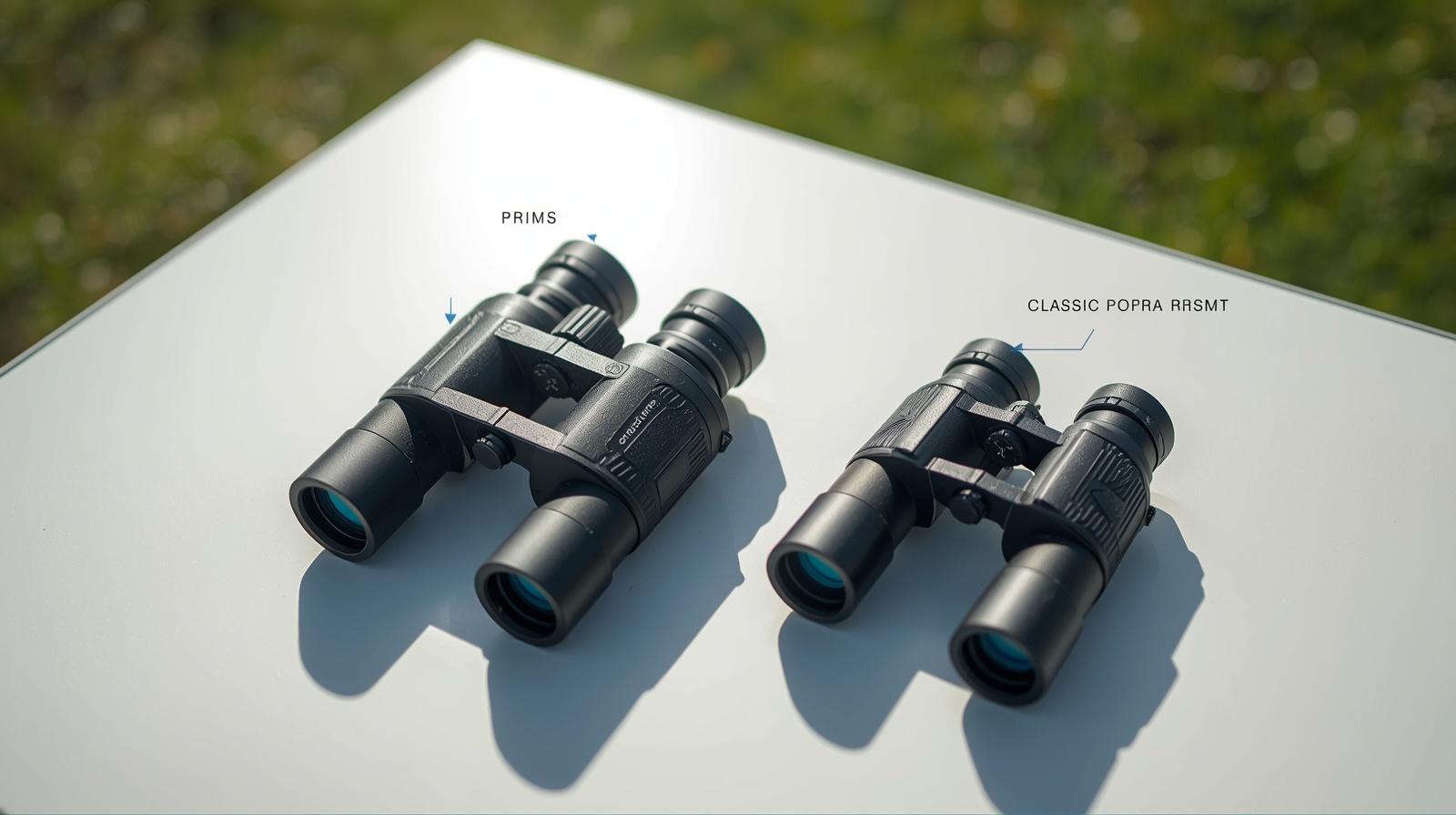
Roof Prism vs Porro Prism for Beginners: Main Differences
Before buying your first pair, focus on the differences you will actually feel.
Not lab numbers. Not fancy marketing words. Real beginner experience.
1. Image Quality
Porro prism binoculars usually give beginners a brighter and more natural-looking image at lower prices.
This is especially noticeable in:
- Evening backyard viewing
- Cloudy outdoor conditions
- Forest edges
- Stadium seats
- Scenic landscapes
- General wildlife viewing
Roof prism binoculars can absolutely beat porro prism binoculars, but usually when you move into better mid-range or premium models.
A $100 porro prism often feels more satisfying than a $100 roof prism. A $500 roof prism may feel sharper, cleaner, and more durable than most beginner porros.
That is the real market truth.
2. Size and Portability
Roof prism binoculars win here.
They are slimmer, straighter, and easier to slip into a daypack. If you are a beginner who wants binoculars for travel, hiking trails, city viewpoints, or general outdoor exploring, roof prism binoculars are easier to live with.
Porro prism binoculars can feel chunky. Some beginners love that stable grip. Others find it annoying after carrying them for an hour.
So ask yourself this:
Will these binoculars mostly stay at home, in the car, or near a window?
Or will you carry them around all day?
If you carry them a lot, roof prism makes more sense.
3. Field of View
Field of view means how wide the scene looks through the binoculars.
For beginners, a wider field of view makes it easier to find and follow objects. This matters a lot when you are new because beginners often struggle to aim binoculars quickly.
Porro prism binoculars often provide a wide, relaxed viewing experience, especially in common beginner sizes like 7×35 and 8×42.
Roof prism binoculars can also have a good field of view, but cheaper models may feel narrower.
For beginners, I usually recommend avoiding overly powerful binoculars like 12x or 16x unless you already know why you need them. High magnification sounds exciting, but it also makes shaking worse and reduces the easy viewing feel.
An 8x binocular is usually the sweet spot.
4. Depth Perception
This is one reason many beginners enjoy porro prism binoculars without knowing why.
Because the objective lenses are spaced farther apart, porro prism binoculars can create a more natural sense of depth. The view can feel less flat, especially when looking across gardens, open fields, hillsides, or layered scenery.
Roof prism binoculars can look very sharp, but the view may feel more compressed, especially in cheaper models.
This does not mean roof prism is bad. It just means porro prism binoculars often feel more “alive” to new users.
5. Durability and Weather Resistance
Modern roof prism binoculars often have an advantage in waterproofing and sealing.
Their straight-body design is easier to seal well. That is why many outdoor and travel binoculars use roof prism construction.
Porro prism binoculars can be durable too, but budget porro models are not always fully waterproof or fogproof. If you plan to use binoculars in wet, humid, dusty, or rough outdoor conditions, check the waterproof and nitrogen-purged details before buying.
For casual beginners, this may not matter much.
For outdoor users, it matters a lot.
Beginner Comparison Table: Roof Prism vs Porro Prism
| Feature | Roof Prism Binoculars | Porro Prism Binoculars |
|---|---|---|
| Body shape | Slim and straight | Wider classic shape |
| Beginner value | Better at mid-range prices | Better at budget prices |
| Portability | Excellent | Average |
| Brightness for price | Good if quality is high | Usually stronger at low budget |
| Depth perception | More compact view | More natural 3D-style view |
| Waterproofing | Often better | Depends on model |
| Ease of holding steady | Good | Often very stable due to wider body |
| Best for | Travel, hiking, compact use | Backyard, casual wildlife, budget buyers |
| Main weakness | Cheap models may underperform | Bulkier and less sleek |
Which One Should Beginners Choose?
Here is the advice I would give a friend buying binoculars for the first time:
Choose porro prism binoculars if you want the best view for your money.
Choose roof prism binoculars if you know you will carry them often and want something compact.
That’s it.
Beginners often overthink prism design and ignore more important things like magnification, weight, eye relief, focus wheel feel, and whether the binocular is comfortable to hold.
A beginner with a comfortable 8×42 porro prism will enjoy viewing more than a beginner with a shaky 12x roof prism bought only because it looked “powerful.”
That is where many first-time buyers go wrong.
Best Beginner Sizes: Don’t Mess This Up
The prism design matters, but size matters just as much.
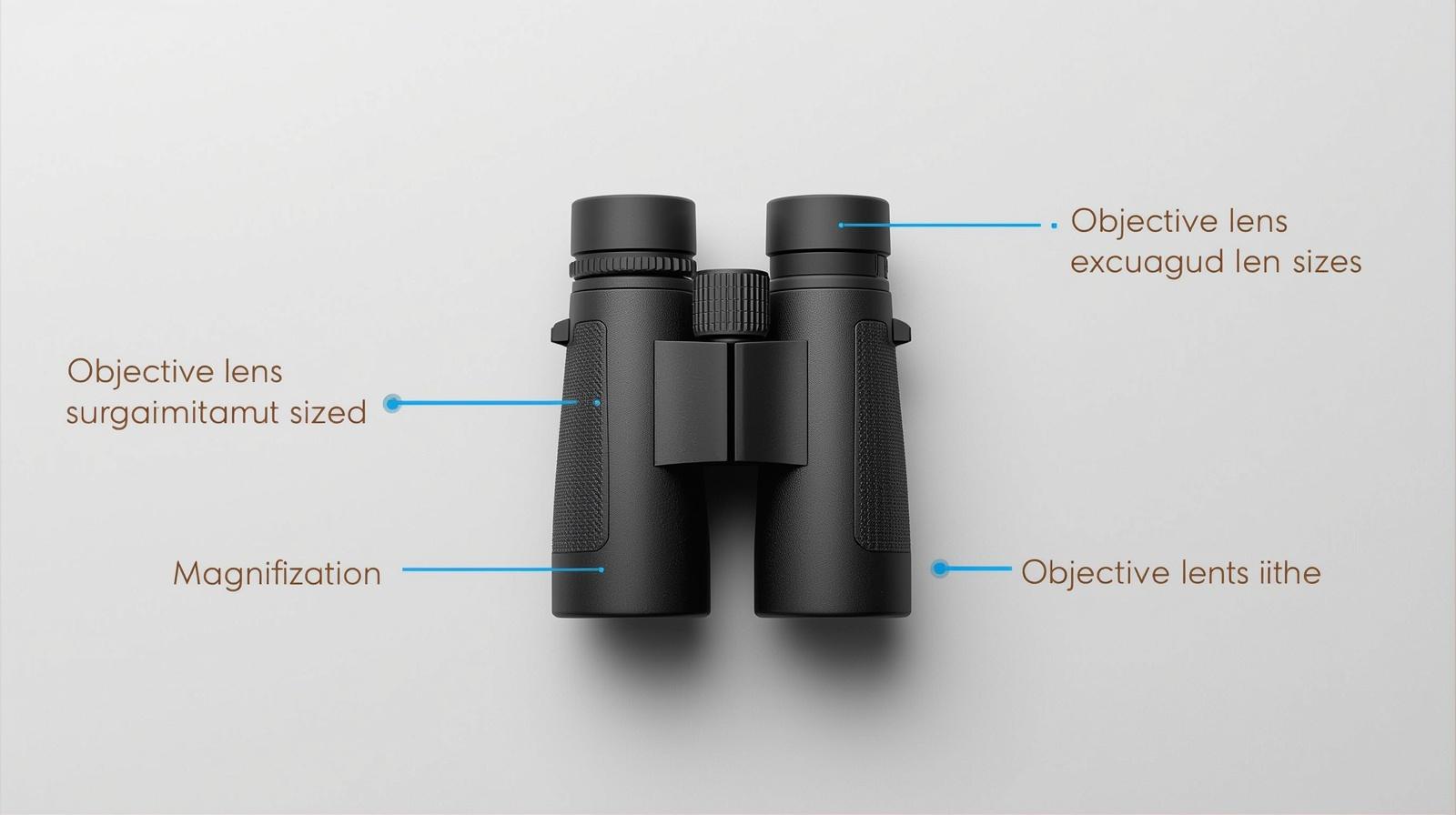
8×42: Best All-Round Beginner Size
For most people, 8×42 binoculars are the safest beginner choice.
They offer:
- Steady image
- Good brightness
- Comfortable viewing
- Useful field of view
- Enough magnification for most outdoor uses
If you are stuck between several options, start with 8×42.
10×42: Better Reach, More Shake
A 10×42 binocular brings objects closer, but it also magnifies hand movement more.
Beginners often buy 10x because it sounds stronger. But if your hands shake or you use binoculars for long periods, 8x may actually feel better.
7×35: Underrated for Casual Beginners
A 7×35 porro prism binocular can be surprisingly enjoyable. It usually gives a wide, steady view and feels very relaxed.
This is great for backyard viewing, sports, scenery, and general beginner use.
10×50: Good for Distance, Bigger to Carry
A 10×50 porro prism binocular can be bright and powerful, but it is heavier.
It is better for users who don’t mind size and want a stronger view from a fixed location.
Real-World Use Cases
Backyard Bird Watching and Window Viewing
For this, porro prism binoculars are hard to beat.
They usually give a bright, wide, easy view. Beginners can locate movement faster and enjoy more depth in the scene.
A porro prism 8×42 or 7×35 works beautifully for this kind of relaxed use.
For a deeper comparison, you can read our main guide on porro prism vs roof prism binoculars before choosing your first pair.
Travel and Hiking
Roof prism binoculars make more sense for travel.
They fit into bags better, hang more comfortably from a strap, and feel less bulky during long walks.
If your binoculars are too annoying to carry, you will leave them behind. That is why portability matters more than many beginners think.
Sports and Events
Both designs can work.
For stadiums, racing, outdoor events, and general viewing, I would choose something light and easy to aim. An 8x binocular usually works better than a high-power model.
Roof prism wins for portability. Porro prism wins for value.
Adult Field Optics and Long-Distance Outdoor Use
Some readers compare binoculars for adult field activities where distance, weather, and fast handling matter. In that case, your prism choice depends more on durability and handling than just brightness. For that angle, see porro vs roof prism binoculars for hunting as a separate use-case comparison.
Budget Learning and First-Time Testing
If you are not sure whether binoculars will become a serious hobby, buy a good porro prism first.
You can learn what a bright image, wide view, and comfortable focus feel like without spending too much.
Later, if you want something more compact and premium, upgrade to a better roof prism binocular.
Pros and Cons of Roof Prism Binoculars for Beginners
Pros
- Roof prism binoculars are easier to carry because of their slim and compact design.
- They feel modern, simple, and beginner-friendly.
- They are a good option for beginners who want a grab-and-go binocular.
- Many roof prism binoculars come with waterproof and fogproof protection.
- Good-quality roof prism binoculars feel clean, balanced, and premium in hand.
Cons
- Cheap roof prism binoculars can be disappointing.
- Some low-quality models look stylish but produce a dull or narrow image.
- Beginners may think all binoculars are the same until they compare image quality side by side.
The main issue is price. To get strong performance from roof prism binoculars, you usually need to spend more.
Pros and Cons of Porro Prism Binoculars for Beginners
Pros
- Porro prism binoculars usually offer better image quality for the money.
- They often give a bright, wide, and natural view.
- Their wider body can make them easier to hold steady.
- They are helpful for beginners who struggle with hand shake.
- For casual viewing, porro prism binoculars are often underrated.
Cons
- Porro prism binoculars are bulkier than roof prism binoculars.
- Some models are not as weather-sealed as roof prism options.
- They may look old-school compared to sleek modern designs.
- Their larger size can put off buyers who want something compact and stylish.
But honestly, beginners should not judge binoculars by looks alone. The view matters more.
For a more opinion-based breakdown, check are porro prism binoculars better because that question depends heavily on budget and use case.
One Product Recommendation That Makes Sense
If you want a beginner-friendly porro prism option, the Nikon ACULON A211 8×42 is worth considering.
It is not the smallest binocular. It is not a premium waterproof roof prism. But for beginners who want a bright, easy, affordable viewing experience, it makes sense as a first serious pair.
Nikon lists the ACULON A211 line as Porro prism type with central focusing, multilayer coating, rubber coating, and an 8×42 version with 8x magnification, 42mm objective lenses, 140m field of view at 1,000m, and 755g weight.
Why it fits beginners:
- 8x is easier to hold steady than 10x or 12x
- 42mm objective lenses are useful for general outdoor brightness
- Porro prism design gives strong value
- The wider body feels stable in the hands
- It helps beginners learn what a proper binocular view should feel like
I would not call it perfect. It is bulkier than a compact roof prism binocular. It is also not the best choice if you want something pocket-friendly for travel.
But as a first pair for backyard use, casual wildlife viewing, scenery, and learning binocular basics, it is a sensible pick.
Common Beginner Mistakes
Mistake 1: Buying Too Much Magnification
More power does not always mean better viewing.
Beginners often buy 12x or 16x binoculars and then wonder why the image shakes. For handheld use, 8x is usually more enjoyable.
Mistake 2: Choosing Looks Over View Quality
Roof prism binoculars often look cooler.
But a cheap roof prism can lose to a good porro prism in brightness, depth, and comfort. Always think beyond design.
Mistake 3: Ignoring Eye Relief
If you wear glasses, eye relief matters.
Look for longer eye relief and comfortable twist-up eyecups. Otherwise, you may not see the full image clearly.
Mistake 4: Buying the Cheapest Unknown Model
Ultra-cheap binoculars often have stiff focus wheels, weak coatings, poor alignment, or uncomfortable eyecups.
A slightly better beginner binocular saves frustration.
Mistake 5: Not Thinking About Where You Will Use It
A porch viewer, a traveler, and a long-walk outdoor user do not need the same binocular.
Your use case should decide your prism type.
Buyer Psychology: What Beginners Really Want
Most beginners say they want “good binoculars.”
But what they really want is this:
They want binoculars that feel easy.
Easy to focus.
Easy to carry.
Easy to hold steady.
Easy to enjoy without adjusting every two minutes.
That is why the best beginner binocular is not always the one with the biggest magnification or the most technical features.
A beginner-friendly binocular should disappear in use. You lift it, focus it, and enjoy the view.
That is the standard.
Final Verdict: Roof Prism vs Porro Prism for Beginners
For beginners, porro prism binoculars are usually the smarter first buy on a budget.
They give you more optical value, often a brighter image, and a more natural viewing experience without forcing you into premium pricing.
But if you want a compact binocular for hiking, travel, or everyday carry, roof prism binoculars are the better practical choice.
Here is the clean recommendation:
Start with an 8×42 porro prism if value and image quality matter most.
Start with an 8×42 roof prism if portability and weather-resistant handling matter more.
Avoid chasing high magnification too early. Learn what a comfortable, bright, steady view feels like first. Once you know that, upgrading becomes much easier.
For more beginner-friendly binocular comparisons and buying advice, visit the Best Binocular home page or explore the blog tips section for more practical guides.
FAQs About Roof Prism vs Porro Prism for Beginners
Are roof prism binoculars better for beginners?
Roof prism binoculars are better for beginners who want something compact, modern, and easy to carry. They are especially useful for travel, hiking, and outdoor use. However, cheap roof prism binoculars may not give the best image quality for the price.
Are porro prism binoculars better for beginners?
Porro prism binoculars are often better for beginners on a budget because they usually provide a brighter, wider, more natural view for less money. They are bulkier, but the viewing experience can be excellent for the price.
Which is cheaper, roof prism or porro prism binoculars?
Porro prism binoculars are usually cheaper when comparing similar optical performance. Roof prism binoculars require more precise construction and coatings, which often makes good models more expensive.
Which binocular type is best for bird watching beginners?
For beginner bird watching, an 8×42 porro prism binocular is a strong choice if you want value and a wide, bright view. A compact 8×42 roof prism is better if you walk a lot and want something easier to carry.
Should beginners buy 8×42 or 10×42 binoculars?
Most beginners should start with 8×42 binoculars. They are easier to hold steady, usually provide a wider field of view, and work well in many lighting conditions. 10×42 is better when you need more reach and can handle extra image shake.
Do porro prism binoculars look outdated?
Some porro prism binoculars look more traditional, but that does not make them worse. In many budget ranges, porro prism binoculars still deliver excellent viewing value.
Are roof prism binoculars worth the extra money?
Roof prism binoculars are worth paying extra for if you need portability, better sealing, and a slimmer body. But at very low prices, porro prism binoculars may give a better image.
What is the easiest binocular type for beginners to use?
The easiest beginner setup is usually an 8×42 binocular with a smooth focus wheel, comfortable eyecups, and manageable weight. The prism type matters, but comfort and usability matter just as much.




