
What Makes Binoculars Good for Deer Hunting
Finding the best deer hunting binoculars is not about buying the biggest glass or the most expensive name on the shelf.
It is about seeing deer before they see you.
That sounds simple, but any serious deer hunter knows how tricky it gets in real cover. A whitetail can blend into a gray timberline like smoke. A mule deer can stand half-hidden on a sage slope while your eyes keep sliding right past him. At first light, every stump starts looking alive. At last light, every shadow starts lying to you.
Good binoculars solve that problem.
The right pair helps you pick apart brush, judge movement, scan field edges, confirm antler detail, and stay behind the glass longer without eye fatigue. The wrong pair makes you squint, over-scan, miss detail, and eventually lower the binoculars right when the woods start getting interesting.
If your main hunting style is deer hunting, your binocular choice should match deer behavior, not just a spec chart. This article breaks down the best deer hunting binoculars by real-world hunting situations: treestand sits, ground blinds, open fields, timber pockets, ridge glassing, and those magic 20 minutes before dark.
What Makes the Best Deer Hunting Binoculars Different?
Deer hunting asks something different from binoculars than elk hunting, birding, or long-range scouting.
You are often glassing shorter distances, tighter cover, broken shadows, field edges, creek bottoms, and brush lanes. You may not need extreme magnification every time. You do need a clean image, steady handling, fast focus, strong low-light performance, and enough field of view to catch subtle movement.
That is why the best deer hunting binoculars usually sit in the 8×42, 10×42, or occasionally 10×50 range.
An 8×42 gives you a wider, steadier view in timber. A 10×42 gives you more detail across fields and cutovers. A 10×50 can help in low light, but it adds bulk. Bigger is not always better when you are climbing into a stand, carrying layers, dragging gear, and trying not to sound like a hardware store falling down a staircase.
For most deer hunters, the sweet spot is simple: 10×42 for mixed terrain or 8×42 for thick woods.
If you hunt multiple setups during the season, a high-quality 10×42 is usually the most versatile choice.
Quick Comparison: Best Deer Hunting Binocular Sizes
| Binocular Size | Best For | Main Strength | Main Weakness |
|---|---|---|---|
| 8×42 | Thick timber, treestands, close whitetail cover | Wider field of view and steadier image | Less detail at longer range |
| 10×42 | Fields, cutovers, mixed terrain, mule deer country | Better reach without too much bulk | Slightly harder to hold steady |
| 10×50 | Low-light field edges and longer sits | Brighter feel in dim conditions | Heavier around the neck |
| 12×50 | Open country scouting from a tripod | More detail at distance | Too shaky handheld for many hunters |
If you only hunt dense woods, 8×42 makes a lot of sense. If you hunt soybean fields, powerline cuts, CRP edges, clear-cuts, farm lanes, or western mule deer terrain, 10×42 feels more useful.
That is why most hunters searching for the best deer hunting binoculars should start with 10×42 and only move away from it if their terrain demands something different.
Best Overall Product Pick: Swarovski NL Pure 10×42
If I had to recommend one premium pair for serious deer hunters, I would shortlist the Swarovski NL Pure 10×42 first.
Not because every deer hunter needs Swarovski-level glass. Many do not.
But for hunters comparing premium optics, this model makes sense because it solves the problems serious deer hunters actually complain about: eye fatigue, narrow viewing, poor edge detail, weak contrast in fading light, and uncomfortable long sits behind the glass.
The NL Pure 10×42 gives you the reach of 10x magnification while still feeling comfortable enough for long scanning sessions. That matters when you are not just “looking around.” You are slowly dissecting a field corner, checking a fence gap, watching an oak flat, or trying to decide whether that gray patch behind the cedar is a shoulder, a log, or your imagination playing games.
Why It Fits Deer Hunting So Well
The biggest advantage is the viewing experience. It feels relaxed. You do not feel like you are fighting the binoculars. When glass is comfortable, you use it more. When you use it more, you spot more deer.
That is the boring truth behind premium optics.
The best deer hunting binoculars are not always the ones with the highest magnification. They are the ones you keep raising to your eyes because the view feels natural.
Pros
| Pros | Why It Matters for Deer Hunting |
|---|---|
| Excellent edge-to-edge clarity | Helps when scanning field edges and timber gaps |
| Comfortable handheld design | Useful during long sits and slow glassing |
| Strong low-light performance | Helps at dawn and dusk when deer move most |
| Wide, immersive view | Makes it easier to catch movement |
| Premium build quality | Better long-term confidence in rough weather |
Cons
| Cons | Why It Matters |
|---|---|
| Expensive | Overkill for casual weekend hunters |
| Premium glass demands care | You will want a good harness and lens protection |
| 10x can show hand shake | Not as naturally steady as 8x in tight timber |
This is not the pair I would push on a beginner who hunts twice a year behind the barn. But for a serious hunter building a high-end kit, the Swarovski NL Pure 10×42 is one of the strongest choices for deer, elk, and general big-game glassing.
For a broader premium comparison, you can also read the main silo article on Best High-end Binoculars for Hunting before choosing your final pair.
8×42 vs 10×42 for Deer Hunting
This debate never dies because both sides are right.
An 8×42 binocular is easier to hold steady. It gives you a wider field of view, which helps when a deer slips through timber. It also feels less jumpy when your heart rate is up, your hands are cold, or you are twisted sideways in a treestand trying to look through a tiny shooting lane.
A 10×42 binocular gives you more reach. That helps across crop fields, clear-cuts, logging roads, and western terrain. You can study antler shape better, separate deer from brush faster, and scan far field edges without feeling underpowered.
So which one belongs in a list of the best deer hunting binoculars?
For most hunters, 10×42 wins because it handles more situations. It is strong enough for open country but still manageable in the woods. However, if your deer hunting happens almost entirely inside 150 yards, an 8×42 may feel better every single day.
Choose 8×42 If You Hunt:
| Hunting Situation | Why 8×42 Works |
|---|---|
| Thick hardwoods | Wider view catches movement faster |
| Treestands in close cover | Easier to scan without over-magnifying |
| Swamps and creek bottoms | Better handheld stability |
| Still-hunting | Less shake while moving slowly |
| Short-range whitetail setups | Enough power without extra twitch |
Choose 10×42 If You Hunt:
| Hunting Situation | Why 10×42 Works |
|---|---|
| Food plots | Better detail across open areas |
| Crop fields | Easier to identify deer at distance |
| Clear-cuts | More useful reach |
| Western mule deer terrain | Better for open scanning |
| Mixed farms and timber | Strong all-around balance |
Here is my honest take: if you are unsure, buy a very good 10×42. If you already know your hunting is tight, dark, and brushy, buy a very good 8×42.
Low Light Matters More Than Most Hunters Admit
Deer do not care about your schedule.
They move when the light gets ugly. Early morning. Late evening. Cloudy drizzle. Snowy gray afternoons. Last ten legal minutes. That is exactly when cheap binoculars start to fall apart.
Low-light performance is not just about brightness. Contrast matters more than many buyers realize. A cheap binocular may look bright enough at noon, then turn flat and muddy at dusk. A better binocular separates brown hide from brown brush. It helps you see shape, movement, and texture.
That is why the best deer hunting binoculars need quality coatings, good glass, a comfortable exit pupil, and clean contrast. You are not trying to admire scenery. You are trying to make quick, confident decisions when the woods are dim.
If your main problem is seeing clearly at dawn and dusk, you should also compare this article with the supporting guide on best low light hunting binoculars. Low-light hunting is where premium optics start proving their worth fast.
Field of View Is Your Secret Weapon
A lot of hunters obsess over magnification and ignore field of view.
Bad move.
Field of view controls how much area you see through the binoculars. In deer hunting, that can be the difference between catching a flicker of movement and staring too tightly at one empty patch.
A wider field of view helps when deer are moving through trees, crossing openings, feeding along edges, or appearing for only a few seconds. It also reduces that “tunnel vision” feeling some binoculars create.
This is one reason premium 10×42 binoculars can feel better than cheaper 10×42 models. Same magnification on paper. Completely different experience in the field.
When you are buying the best deer hunting binoculars, look beyond power. Ask yourself: can I scan naturally with these, or do they make me work too hard?
Real-World Deer Hunting Scenarios
Scenario 1: Treestand in Thick Timber
You are 18 feet up, tucked into oaks and maples. The longest opening is maybe 90 yards. Most deer appear as pieces: leg, shoulder, ear, antler tip.
In this setup, 8×42 shines. You do not need huge magnification. You need a wide, steady view and quick focus. You are watching lanes, shadows, and movement.
A 10×42 still works, especially if the glass is steady and comfortable, but cheap 10x binoculars can feel too twitchy here.
Scenario 2: Food Plot or Crop Field
You are watching a field edge where deer may step out anywhere from 80 to 400 yards. You need to scan corners, check trails, and judge whether a buck is worth staying patient for.
This is classic 10×42 country.
The best deer hunting binoculars for this setup should give you enough detail to study deer without making you reach for a spotting scope every five minutes.
Scenario 3: Clear-Cut Whitetail Hunting
Clear-cuts are messy. Stumps, brush, slash piles, shadows, and deer all blend together. You need contrast and sharpness more than raw power.
A premium 10×42 is excellent here because it helps you pick apart the chaos. A lower-quality binocular may show the same area, but it will not help your brain separate the details as easily.
Scenario 4: Western Mule Deer Glassing
Mule deer hunting often means longer glassing sessions. You may sit on a ridge and scan slopes, draws, brush pockets, and shaded folds.
A 10×42 is a strong handheld choice. If you glass for hours, mount it on a tripod or consider a higher-power setup. But for carrying, stalking, and general hunting, 10×42 remains hard to beat.
For hunters who want distance tools built into the optic, the supporting article on best rangefinding binoculars for hunting is worth reading next. Rangefinding binoculars can simplify your setup when distance judgment matters.
What Deer Hunters Usually Get Wrong
Most deer hunters do not buy bad binoculars because they are careless. They buy bad binoculars because the specs look convincing.
A box says “10x,” “HD,” “waterproof,” and “fully coated,” so it feels like enough.
Then opening morning arrives.
The focus wheel is stiff. The image feels narrow. The edges blur. The view gets dull in low light. Eye relief feels uncomfortable with glasses. The neck strap is annoying. After two hours, the binoculars stay in the pack.
That is the real failure.
The best deer hunting binoculars are not only sharp. They are easy to live with. They balance well in your hands. They focus smoothly with gloves. They do not punish your eyes. They make you want to glass more, not less.
And in deer hunting, more glassing often means more opportunities.
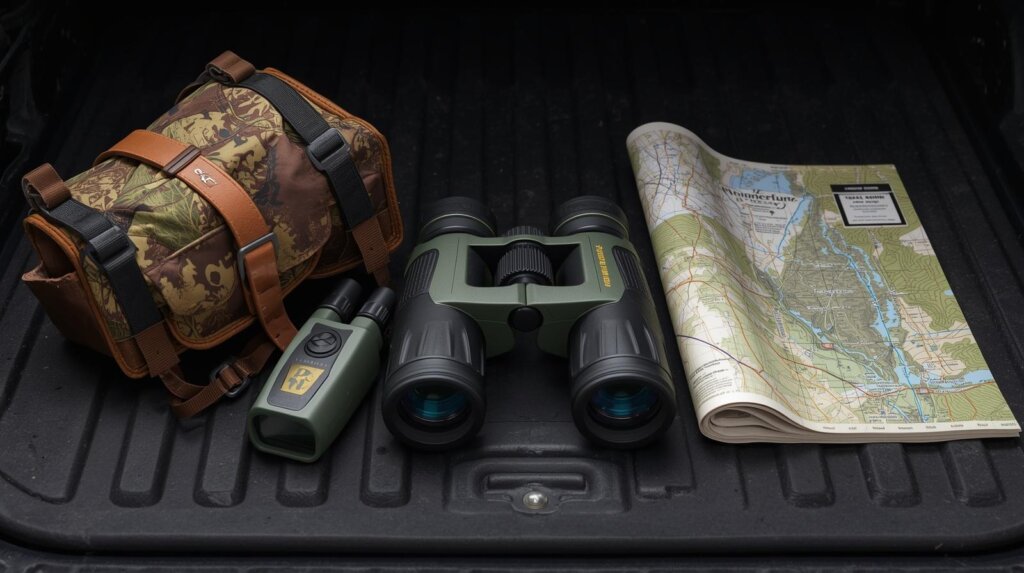
Common Mistakes When Buying Deer Hunting Binoculars
Buying Too Much Magnification
A 12x binocular sounds powerful, but handheld shake can ruin the advantage. Unless you plan to tripod-mount it, 12x is often too much for normal deer hunting.
Ignoring Weight
Heavy binoculars seem fine in the store. After a long walk, cold weather layers, a backpack, weapon, safety harness, and snacks, every ounce starts sending invoices.
Choosing Cheap Glass for Low-Light Hunts
If most deer activity happens at dawn and dusk, cheap optics cost you more than money. They cost you usable minutes.
Forgetting Eye Relief
If you wear glasses, check eye relief carefully. A great binocular can feel terrible if you cannot see the full image comfortably.
Skipping the Harness
A premium binocular deserves a good chest harness. It protects the glass, keeps it quiet, and stops the binocular from swinging every time you climb, crawl, or kneel.
What I Would Actually Buy for Different Deer Hunters
| Hunter Type | Best Binocular Choice | Why |
|---|---|---|
| Thick timber whitetail hunter | 8×42 | Steady, wide, fast |
| Mixed terrain deer hunter | 10×42 | Best all-around balance |
| Food plot hunter | 10×42 | Strong detail across fields |
| Low-light evening hunter | Premium 8×42 or 10×42 | Better contrast and brightness |
| Western mule deer hunter | 10×42, tripod optional | Versatile for open country |
| Gear minimalist | 10×42 | One pair can do almost everything |
If you want one pair and do not want to overthink it, buy the best 10×42 you can afford. That advice sounds simple because it is. Deer hunting already has enough variables. Your binoculars should not add another problem.
Final Verdict: The Best Deer Hunting Binoculars Are the Ones You Keep Using
The best deer hunting binoculars are not always the flashiest pair. They are the pair that helps you stay observant longer.
For thick woods, an 8×42 can be perfect. For most hunters, a premium 10×42 offers the best balance of reach, brightness, detail, and carry comfort. For serious high-end buyers, the Swarovski NL Pure 10×42 stands out because it feels easy, sharp, immersive, and trustworthy in the exact moments deer hunters care about most.
Do not buy binoculars only for noon in a parking lot.
Buy them for gray mornings, wet sleeves, foggy breath, shaking hands, narrow lanes, silent field edges, and the last few minutes when the whole hunt can change.
That is where good glass earns its place.
For more field-tested optics help, browse the latest guides on our blog page or return to the bestbinocular.net home page to explore more hunting binocular comparisons.
FAQs About the Best Deer Hunting Binoculars
What are the best deer hunting binoculars for most hunters?
The best deer hunting binoculars for most hunters are high-quality 10×42 binoculars. They offer enough magnification for fields, food plots, clear-cuts, and mixed terrain while staying light enough for treestands and all-day carry.
Are 8×42 binoculars good for deer hunting?
Yes, 8×42 binoculars are excellent for deer hunting in thick woods, treestands, creek bottoms, and close-range whitetail cover. They provide a wider field of view and a steadier handheld image than most 10x binoculars.
Are 10×42 binoculars too much for deer hunting?
No, 10×42 binoculars are not too much for deer hunting if you choose a quality pair. They work especially well in fields, open timber, cutovers, farm country, and western mule deer terrain. Hunters with shaky hands may prefer 8×42.
What magnification is best for whitetail deer hunting?
For whitetail deer hunting, 8×42 is best for thick woods, while 10×42 is better for mixed terrain and open fields. If you hunt several property types, 10×42 is usually the safer all-around choice.
Do deer hunters need expensive binoculars?
Not every deer hunter needs expensive binoculars, but serious hunters benefit from better glass. Premium binoculars usually offer cleaner contrast, better low-light performance, less eye fatigue, smoother focus, and a more comfortable viewing experience.
Are rangefinding binoculars worth it for deer hunting?
Rangefinding binoculars are worth it if you hunt open fields, western terrain, or situations where distance judgment matters. They combine glassing and ranging into one tool, but they cost more and may be heavier than standard binoculars.
What is more important for deer hunting: brightness or magnification?
Brightness, contrast, and image comfort matter more than extreme magnification. Deer often move in low light, so the best deer hunting binoculars should help you see detail clearly at dawn and dusk rather than simply zoom farther.
Should I use a tripod with deer hunting binoculars?
A tripod is useful for long glassing sessions, open country, and mule deer hunting. For treestand whitetail hunting, handheld binoculars are usually enough. If you use 12x or higher magnification, a tripod becomes much more important.




