
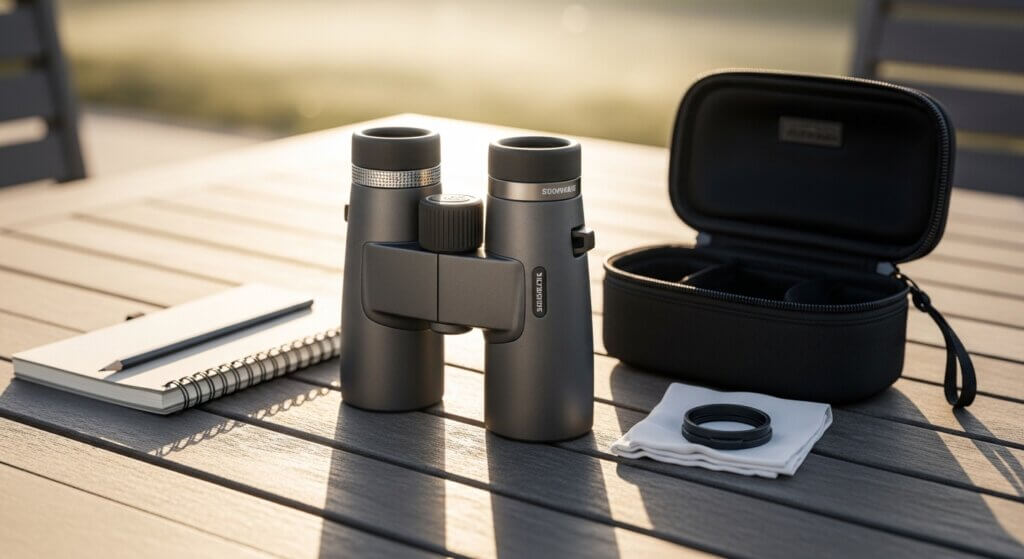
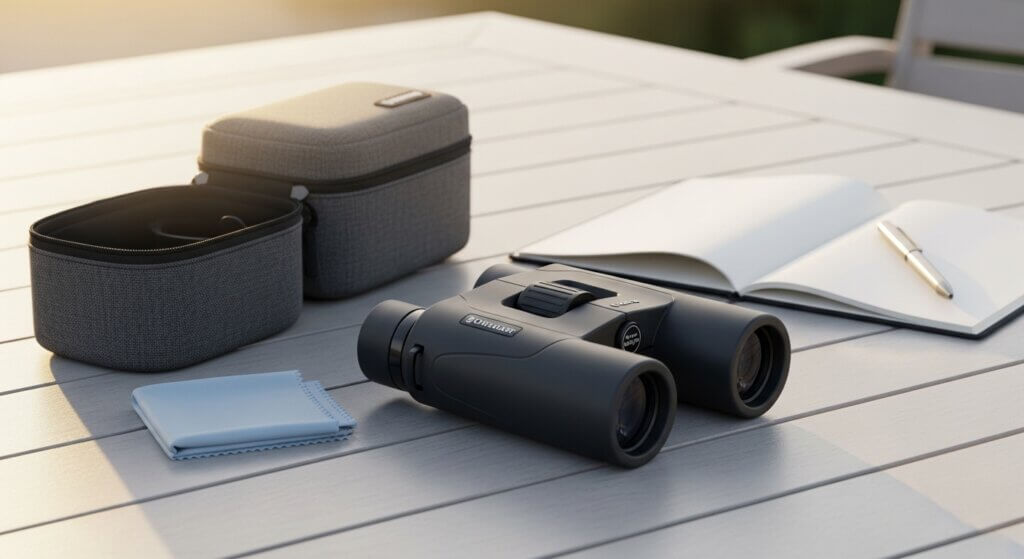
Buying your first binoculars sounds simple until you see numbers like 8×42, 10×50, roof prism, Porro prism, BaK-4 glass, field of view, eye relief, close focus, and “fully multi-coated optics.” That is where most beginners either overspend, buy something too powerful, or grab a tiny pair that looks convenient but feels useless outside.
The truth is blunt: the best binoculars for beginners are not always the most expensive binoculars. They are the pair you can hold steady, focus quickly, carry without hating the weight, and actually use in real life.
For most new users, that means an 8×42 binocular. It gives enough magnification to enjoy birds, wildlife, sports, hiking views, boats, landscapes, and backyard watching without making the image shaky. It also lets in enough light to work in early morning and late afternoon, which is when most interesting outdoor viewing happens.
This article is written for one clear purpose: helping you choose the best binoculars for beginners without getting trapped by confusing specs or shiny marketing claims.
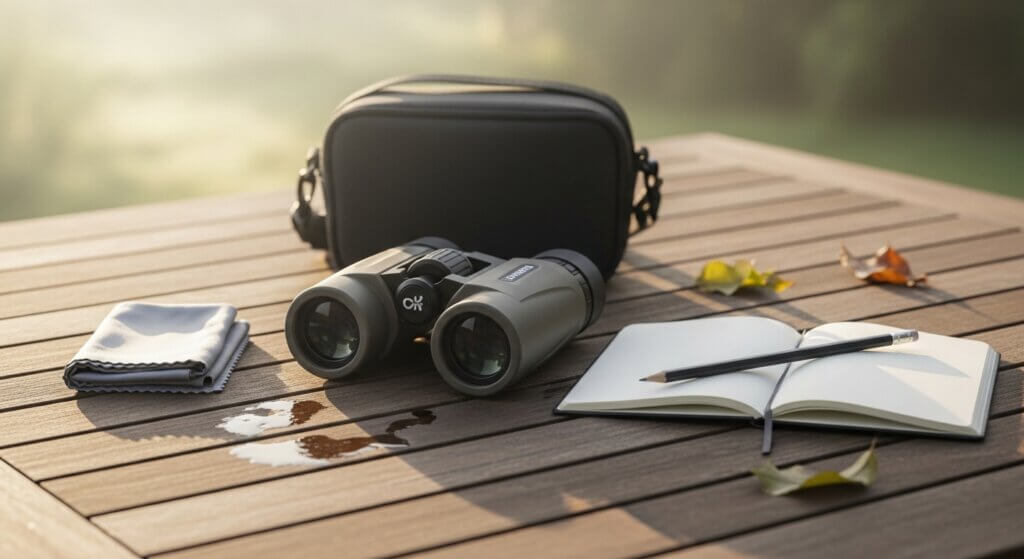
What Beginners Actually Need From Binoculars
A beginner does not need museum-grade optics. You do not need a $1,000 pair to enjoy a bird on a fence, a deer near the tree line, a football game from the upper seats, or mountain views on a weekend trip.
You need three things first:
- A clear image
- A steady view
- A comfortable body that you will actually carry
That sounds basic, but many first-time buyers ignore it. They chase big magnification because “more zoom” feels better. Then they discover that 12x or 16x binoculars are hard to hold still. The view shakes. The image feels narrow. The binoculars become annoying instead of exciting.
That is why the best binoculars for beginners usually sit in the 8x range. An 8x binocular brings distant objects closer, but it still feels calm in the hands. You can follow a moving bird, scan a field, watch a game, or look across a lake without feeling like the image is jumping around.
If you want a deeper overall breakdown before choosing a first pair, read our main silo guide here: Best Binoculars Overall Guide. It helps you compare beginner, everyday, budget, birding, hiking, and general-use options in one place.
Best Beginner Binocular Size: Why 8×42 Wins
The number “8×42” tells you two things.
The first number, 8x, is magnification. It means the view appears eight times closer than your naked eye. The second number, 42, is the size of the front lenses in millimeters.
For beginners, 8×42 is the sweet spot.
It is bright enough for most outdoor use. It is stable enough for handheld viewing. It is not too bulky. It also gives a wider field of view than many higher-power binoculars, which makes it easier to find what you are looking for.
That matters more than beginners realize.
When you are new, you do not instantly “lock on” to a small bird in a tree or a distant object across a valley. You need a wider view so your eyes can find the subject. A narrow, high-magnification binocular can make you feel lost. You keep searching, refocusing, and adjusting until the moment is gone.
That is why many experienced users still keep an 8×42 pair even after they own more expensive models. It is simply practical.
Quick Comparison: Best Beginner Binocular Specs
| Feature | Best Beginner Choice | Why It Matters |
|---|---|---|
| Magnification | 8x | Easier to hold steady and better for moving subjects |
| Objective lens | 42mm | Good brightness without becoming too heavy |
| Focus wheel | Smooth and easy | Helps you react quickly outdoors |
| Eye relief | 15mm+ | More comfortable if you wear glasses |
| Weight | Under 650g if possible | Easier for hiking, travel, and long sessions |
| Waterproofing | Strongly recommended | Outdoor use is unpredictable |
| Field of view | Wider is better | Easier to track birds, sports, and landscapes |
| Prism type | Roof prism for portability | Slimmer and easier to carry |
As a beginner, you do not need to get caught up in every specification. What matters is whether the binocular feels easy to use and gives you a clear, comfortable view. If a feature does not improve the actual viewing experience, it is just a number on the spec sheet.
Best Binoculars for Beginners: My Practical Recommendation
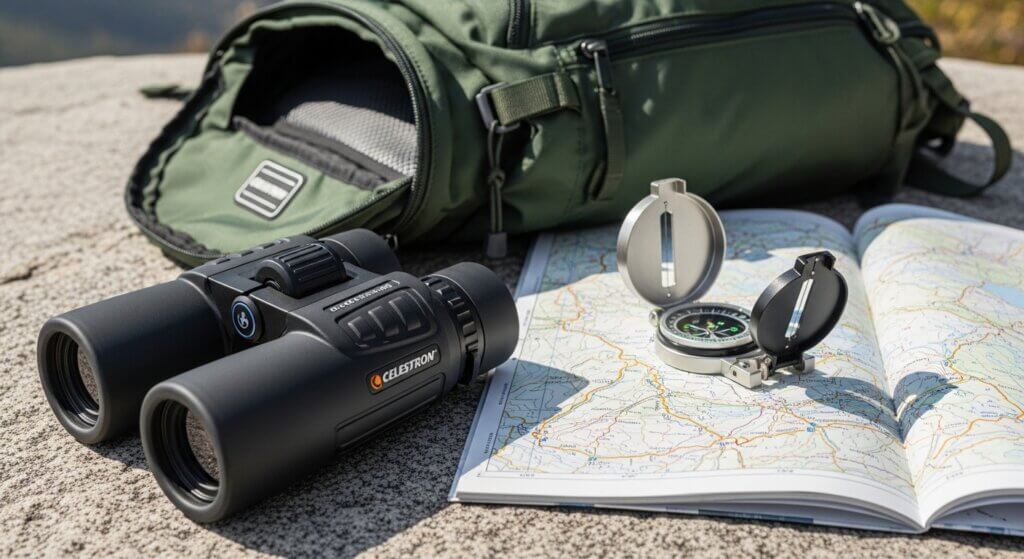
If I had to recommend one highly relevant product for most first-time users, I would choose the Celestron Nature DX 8×42.
Why this one? Because it sits in the right beginner zone. It gives you the classic 8×42 setup, works for bird watching, hiking, travel, backyard use, and general outdoor viewing, and does not push you into premium pricing before you even know how often you will use binoculars.
The Celestron Nature DX 8×42 is commonly positioned as an entry-level outdoor binocular with 8x magnification, 42mm objective lenses, waterproof construction, phase-coated BaK-4 prisms, fully multi-coated optics, 17.5mm eye relief, and a 6.5 ft close focus distance.
Why It Makes Sense for Beginners
The biggest advantage is balance. It is not trying to be a specialist astronomy binocular. It is not a tiny concert binocular. It is not a massive tripod-only pair. It is a simple, useful, outdoor-ready binocular for people learning what they like to watch.
Use it for:
- Backyard bird watching
- Nature walks
- Hiking viewpoints
- Camping trips
- Wildlife spotting
- Outdoor sports
- Lake, beach, and travel views
- General everyday use
That is exactly what a first binocular should do.
Pros
- Easy 8x magnification for steady handheld viewing
- 42mm lenses give better brightness than small compact binoculars
- Good option for birding, hiking, and casual wildlife watching
- Waterproof build is useful for outdoor beginners
- Close focus helps with nearby flowers, insects, feeders, and garden details
- Usually priced low enough for a serious starter pair
Cons
- Edge sharpness may not match premium binoculars
- Not ideal if your main goal is astronomy
- Not as pocketable as small compact binoculars
- The image may not feel as refined as higher-end glass
Here is the honest version: this is not the binocular you buy to impress optics snobs. It is the binocular you buy when you want to stop researching and start using one.
Who Should Buy Beginner Binoculars Like These?
The best binoculars for beginners are perfect for someone who wants one pair that can do several jobs well.
You may be a beginner if you are thinking:
- “I want binoculars for birds, but I may also use them for travel.”
- “I need something for hiking, but I do not want to carry heavy gear.”
- “I want to watch sports from far seats.”
- “I want a gift for someone who enjoys the outdoors.”
- “I do not know enough about optics to spend big money yet.”
In those cases, an 8×42 beginner binocular makes sense. It gives you room to explore. You can learn whether you enjoy bird watching, wildlife spotting, stargazing, travel viewing, or casual backyard use before investing in something more specialized.
If your use is more casual and you want a pair for daily walks, events, and general carry, you may also like this supporting article: best binoculars for everyday use. It focuses more on grab-and-go convenience rather than first-time learning.
8×42 vs 10×42 for Beginners
This is one of the most common beginner questions.
A 10×42 binocular sounds better because it has more magnification. And yes, it brings objects closer. But it also makes hand shake more visible. The field of view is often narrower too. That means it can be harder to find and follow a moving subject.
For beginners, 8×42 usually feels more natural.
Choose 8×42 if:
- You are new to binoculars
- You want less image shake
- You plan to watch birds or moving subjects
- You want a wider view
- You care about comfort during longer use
- You want one pair for many situations
Choose 10×42 if:
- You have steady hands
- You mostly watch distant landscapes or wildlife
- You use binoculars from a fixed position
- You do not mind a slightly narrower view
- You already know you want more reach
My advice is simple: start with 8×42 unless you have a specific reason not to. Beginners usually enjoy it more.
Real-World Use Cases: What Beginner Binoculars Feel Like Outside
Backyard Bird Watching
This is where beginner binoculars often become addictive. You start by looking at one bird on a fence, and suddenly you notice feather patterns, eye rings, colors, and behavior you never saw before.
An 8×42 binocular works well here because it focuses fast and gives enough width to track movement. Small birds do not sit still for your convenience. They hop, turn, hide, and fly. A narrow view makes that frustrating.
Hiking and Scenic Views
On a trail, weight matters. A beginner does not want binoculars that feel like a brick around the neck. A mid-size 8×42 is still noticeable, but it is manageable.
Use them at viewpoints, ridges, lakes, beaches, and open fields. They help you enjoy small details instead of just staring at a distant blur.
Sports and Stadiums
For sports, beginners often think they need strong magnification. Not always. A steady 8x view is usually more enjoyable than a shaky 12x view.
You can follow action better, scan the field, and avoid constantly refocusing.
Travel
For travel, the question becomes size versus comfort. Compact binoculars are easier to pack, but they often feel dimmer and less comfortable. A good beginner 8×42 is better if the trip includes national parks, coastlines, mountain areas, safaris, cruises, or scenic drives.
If you are comparing price and value before buying, read best binoculars for the money. That article is useful when you want the strongest performance without wasting your budget.
Common Mistakes Beginners Make
Mistake 1: Buying Too Much Magnification
This is the classic mistake. A beginner sees 20x or 30x and thinks, “That must be powerful.” It is powerful, but it is often miserable handheld.
High magnification needs stability. Without a tripod, the view shakes. You may see “closer,” but you do not see better.
Mistake 2: Choosing Tiny Binoculars Only Because They Fit in a Pocket
Compact binoculars are useful, but they are not always the best first pair. Many tiny models have smaller lenses, which means less brightness. They can also feel fiddly, especially if you wear glasses.
If you want the best binoculars for beginners, comfort matters more than pocket size.
Mistake 3: Ignoring Eye Relief
Eye relief is the distance your eyes can sit from the eyepiece while still seeing the full image. If you wear glasses, this matters a lot.
Look for generous eye relief, preferably around 15mm or more. If the eye relief is too short, you may see dark edges or a reduced image.
Mistake 4: Thinking Expensive Always Means Better for You
Expensive binoculars can be amazing. But a beginner may not notice the full difference yet. Premium glass, edge sharpness, contrast, and coatings matter more once your eyes know what to look for.
Your first pair should teach you what you enjoy watching.
Mistake 5: Forgetting the Strap
This sounds small, but it changes everything. A bad neck strap makes binoculars feel heavier than they are. If you plan to walk for hours, consider a harness or padded strap.
What You Really Want From Your First Pair
Most beginners are not only buying optics. They are buying confidence.
You want to feel like you made a smart choice. You want a pair that does not embarrass you, confuse you, or sit unused in a drawer. You want binoculars that feel “good enough” on the first day and still useful six months later.
That is why the best beginner binocular is rarely the cheapest one. The cheapest pair may save money today but disappoint you quickly. The image may look dull. The focus may feel rough. The body may feel toy-like.
At the same time, the best beginner binocular is not usually the most expensive either. Spending premium money before understanding your use case is not smart. You may later realize you care more about birding, astronomy, marine use, safari travel, hunting, or sports. Each of those paths can lead to a different ideal binocular.
The smart move is buying a capable starter pair that helps you learn.
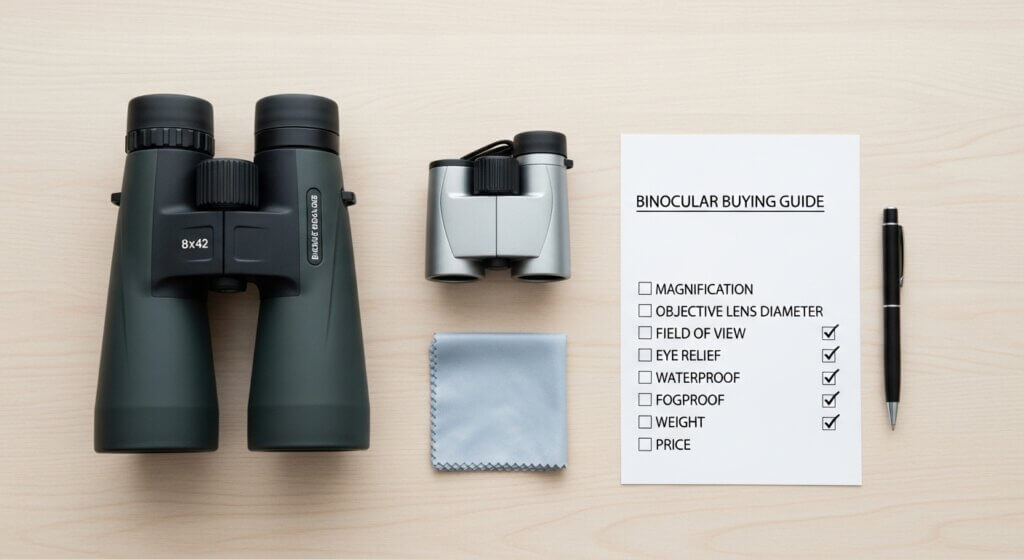
Beginner Binocular Buying Checklist
Before you buy, ask these questions:
| Question | Best Beginner Answer |
|---|---|
| Will I use them handheld? | Yes, choose 8x or 10x max |
| Will I use them outdoors? | Get waterproof or water-resistant binoculars |
| Do I wear glasses? | Check eye relief before buying |
| Will I hike with them? | Watch the weight |
| Will I watch birds? | Prioritize wide field of view and close focus |
| Will I use them at night? | Consider larger lenses, but avoid going too bulky |
| Is this my first serious pair? | Do not overspend too early |
This is where beginners need discipline. Do not buy based on one impressive number. Binoculars are about balance.
Are Cheap Binoculars Worth It for Beginners?
Sometimes, yes. But “cheap” and “good value” are not the same thing.
A very cheap pair can work for occasional use, like a concert or quick vacation. But if you want birding, hiking, wildlife, or regular outdoor use, poor binoculars become annoying fast.
The focus may be stiff. The image may look dim. The edges may blur badly. The hinge may feel loose. The eyecups may not stay in place. You may blame yourself for not enjoying binoculars when the real problem is the equipment.
The best binoculars for beginners should feel easy from the first few minutes. You should not have to fight them.
What About Binoculars for Stargazing?
Beginner stargazing is a slightly different world. For the moon, bright star clusters, and casual sky scanning, binoculars can be fun. But if astronomy is your main goal, 10×50 binoculars are often more useful than 8×42 because the larger front lenses gather more light.
The trade-off is size and steadiness. A 10×50 pair is bigger and heavier. You may also want a tripod for longer sessions.
So here is the clean answer:
For general beginners, choose 8×42.
For beginner astronomy, consider 10×50.
For mixed use, 8×42 is still the safer first buy.
How to Use Beginner Binoculars Properly
Most people use binoculars badly at first. They lift them, squint, twist the focus wheel randomly, and wonder why the image feels uncomfortable.
Set them up once.
First, adjust the hinge until both eyes see one clean circle, not two overlapping circles. Then close your right eye and focus with the center wheel using only your left eye. After that, close your left eye and adjust the diopter for your right eye. Once both eyes are sharp, you can use the main focus wheel normally.
Also, do not press binoculars hard into your face. Let your eyes relax. If you wear glasses, twist the eyecups down. If you do not wear glasses, twist them up.
This small setup step makes beginner binoculars feel much better.
Final Verdict: What Are the Best Binoculars for Beginners?
The best binoculars for beginners are the ones that make viewing feel natural, not technical. For most people, that means an 8×42 pair with comfortable handling, decent waterproofing, smooth focus, and enough optical quality to keep you interested.
My practical pick is the Celestron Nature DX 8×42 because it gives beginners the right mix of usability, outdoor readiness, and value. It is not perfect, and it is not pretending to be. But for birding, hiking, backyard viewing, travel, and general outdoor use, it is a smart first pair.
Start there, learn what you enjoy watching, and upgrade later only when your needs become specific.
For more buying help, visit the homepage at bestbinocular.net, or explore more practical binocular advice on our blog tips page. Those pages can help you move from “I have no idea what to buy” to “I know exactly what I need.”
FAQs About the Best Binoculars for Beginners
What magnification is best for beginner binoculars?
For most beginners, 8x is the best magnification. It gives a closer view without making the image too shaky. It also provides a wider field of view, which helps when watching birds, sports, wildlife, and landscapes.
Are 8×42 binoculars good for beginners?
Yes, 8×42 binoculars are one of the best choices for beginners. They offer a strong balance of brightness, stability, comfort, and versatility. They are useful for bird watching, hiking, travel, backyard viewing, and everyday outdoor use.
Are 10×42 binoculars too powerful for beginners?
Not always, but 10×42 binoculars can feel shakier than 8×42 binoculars. If you have steady hands or mostly view distant objects, 10×42 can work. However, beginners usually find 8×42 easier and more comfortable.
What is the best beginner binocular for bird watching?
A good 8×42 binocular is usually the best beginner choice for bird watching. It gives a wide enough view to find birds quickly and enough magnification to see useful detail. The Celestron Nature DX 8×42 is a strong beginner-friendly option for casual birding and nature watching.
Should beginners buy compact binoculars?
Compact binoculars are good for travel, concerts, and light casual use. But for a first serious pair, they may feel less bright and less comfortable than 8×42 binoculars. If you want better all-around performance, choose a mid-size pair first.
How much should beginners spend on binoculars?
Beginners do not need to spend premium money. A good starter pair often sits in the budget-to-midrange category. Avoid the cheapest no-name models, but do not overspend until you know your main use case.
Are waterproof binoculars necessary?
Waterproof binoculars are strongly recommended for beginners who plan to use them outdoors. Weather changes quickly, and binoculars may face rain, mist, damp grass, beach air, or accidental splashes.
Can beginner binoculars be used for stargazing?
Yes, beginner binoculars can be used for casual stargazing, especially for the moon and bright sky objects. However, if astronomy is your main goal, a 10×50 pair may be better because it gathers more light.
What does 8×42 mean on binoculars?
The 8 means the binoculars magnify the view eight times. The 42 means the front lenses are 42mm wide. For beginners, 8×42 is popular because it gives a bright, steady, and comfortable viewing experience.
What is the biggest mistake beginners make when buying binoculars?
The biggest mistake is buying too much magnification. High-power binoculars sound impressive, but they are harder to hold steady. A clear, stable 8x view is usually more useful than a shaky 12x or 16x view.




