
Porro vs Roof Prism Binoculars for Hunting: Which One Fits the Field Better?
Choosing between porro vs roof prism binoculars for hunting sounds like a small optics decision, but in the field, it can change how fast you spot movement, how comfortable your glassing feels, and how much gear weight you carry all day.
Here’s the honest thing: both designs can work for hunting.
But they do not work the same way.
A porro prism binocular usually gives you a wider, deeper image for less money. A roof prism binocular is usually slimmer, tougher, easier to carry, and better suited for serious field abuse. That is why most modern hunting binoculars use roof prism designs, while many budget hunters still like porro models for their value.
So the real question is not simply “which is better?”
The better question is:
Which prism design fits your hunting style, terrain, budget, and patience level?
That is what this guide breaks down.
Quick Answer: Roof Prism Is Better for Most Hunters, Porro Is Better for Budget Glassers
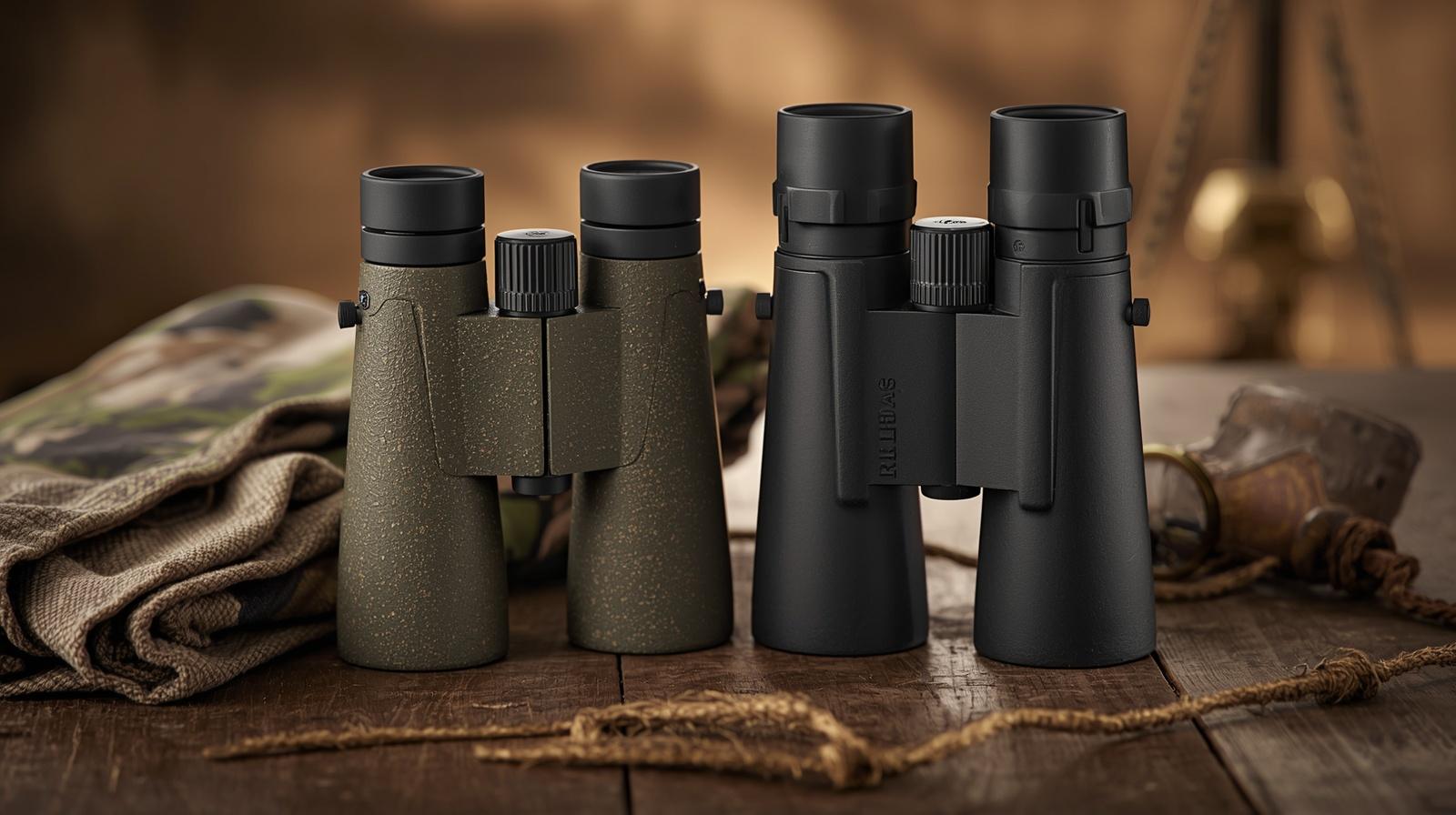
For most hunters, roof prism binoculars are the safer choice. They are compact, easier to waterproof, easier to pack, and more durable for rough terrain. If you hunt deer, elk, turkey, hogs, or western big game, a good 8×42 or 10×42 roof prism binocular will usually feel more practical.
But porro prism binoculars still have a place.
If you are hunting from a blind, truck, cabin, farm edge, or fixed position, porro binoculars can give you excellent image depth and brightness without draining your wallet.
That is why the porro vs roof prism binoculars for hunting debate depends heavily on how you hunt.
If you are still comparing the basic prism designs, read the main silo guide here: porro prism vs roof prism binoculars. It explains the core optical differences before you choose a hunting model.
What Makes Hunting Binoculars Different from Casual Binoculars?
Hunting binoculars are not just about magnification.
A hunting binocular needs to survive real use. Dust, cold mornings, sudden rain, thick brush, rocky trails, truck storage, tree stands, and long glassing sessions all expose weak optics fast.
A casual binocular may look fine in the backyard. A hunting binocular needs to perform when the light is fading and you are trying to decide whether that shape near the timberline is worth stalking.
For hunting, the key factors are:
| Feature | Why It Matters for Hunting |
|---|---|
| Low-light performance | Dawn and dusk are prime movement times |
| Field of view | Helps scan timber, hillsides, and open country faster |
| Durability | Hunting gear gets bumped, dropped, and packed hard |
| Waterproofing | Rain, fog, and wet grass can ruin weak binoculars |
| Weight | Heavy glass becomes annoying on long walks |
| Focus speed | Fast target identification matters in changing terrain |
| Eye relief | Important if you wear glasses or glass for long periods |
This is where the prism design becomes important.
Porro binoculars and roof binoculars solve these needs differently.
Porro Prism Binoculars for Hunting: The Old-School Value Pick
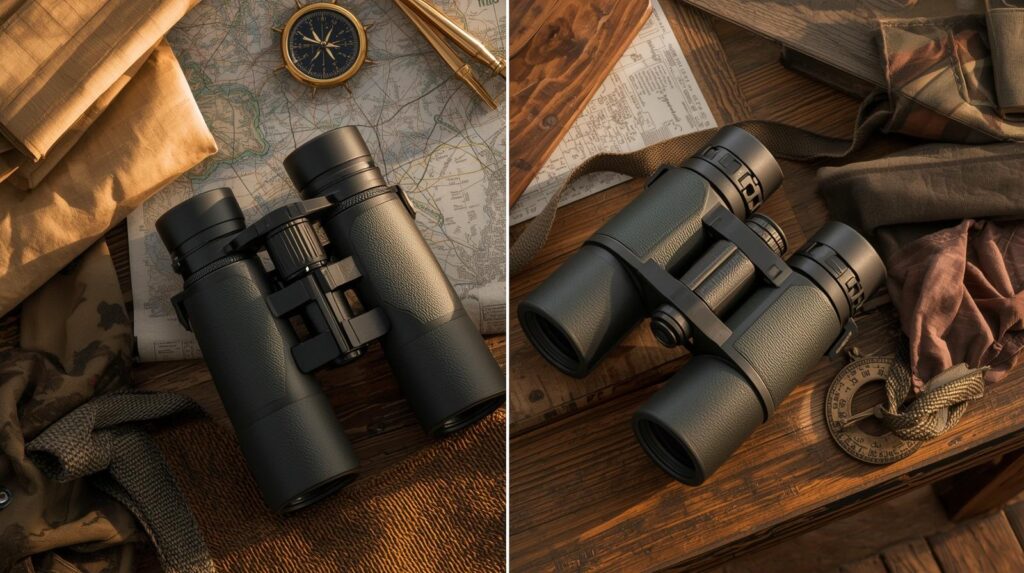
Porro prism binoculars have that classic wider shape. The objective lenses sit farther apart than the eyepieces, giving them a slightly offset body design.
That shape is not just style. It creates a strong sense of depth.
In the field, porro binoculars can make trees, rocks, ridgelines, and brush layers feel more separated. For hunters glassing across mixed terrain, that 3D-like image can be useful.
Where Porro Binoculars Work Well for Hunting
Porro prism binoculars are best when you are not constantly moving.
They make sense for:
- Ground blind hunting
- Treestand hunting
- Farm edge scouting
- Truck-based glassing
- Short walks to a fixed spot
- Budget hunters who want better image quality per dollar
A decent porro can look surprisingly good in early morning light. Because the design is simpler to manufacture, you often get better optical value at lower prices.
That is the main reason some hunters still defend porro binoculars hard.
And honestly? They have a point.
A cheap roof prism binocular can look dull, narrow, or soft around the edges. A porro binocular at the same price may give you a brighter and more natural-looking image.
For more on this value angle, you can read: why are porro prism binoculars cheaper. That article explains why porro optics often cost less without automatically being “bad.”
Pros of Porro Prism Binoculars for Hunting
| Porro Prism Advantage | Real Hunting Benefit |
|---|---|
| Better depth perception | Easier to separate brush, trees, and terrain layers |
| Strong value for money | Good image quality at lower prices |
| Often bright for the cost | Useful during early morning and evening glassing |
| Wider body gives stable grip | Comfortable for stationary glassing |
| Simple optical design | Less expensive to produce |
Cons of Porro Prism Binoculars for Hunting
Porro prism binoculars are not perfect.
Their biggest problem is field practicality.
They are bulkier. They are harder to fit into a chest harness. Many budget porro models are not sealed as well as modern roof prism binoculars. And once you start walking through brush, climbing, or packing light, that wide body can feel awkward.
The exposed external shape also makes them easier to bump.
That does not mean porro binoculars are fragile by default. Some are built well. But compared to modern roof prism hunting binoculars, porro designs usually feel less streamlined.
Roof Prism Binoculars for Hunting: The Modern Field Choice
Roof prism binoculars have a straight-barrel design. The eyepieces and objective lenses line up more closely, giving the binocular a slim and compact shape.
This design is the reason most premium hunting binoculars today are roof prism models.
When people talk about serious hunting binoculars, they are usually talking about roof prism binoculars.
Why Hunters Prefer Roof Prism Binoculars
Roof prism binoculars are easier to carry. That sounds basic, but in hunting, basic comfort matters a lot.
If your binoculars are annoying to wear, you will use them less.
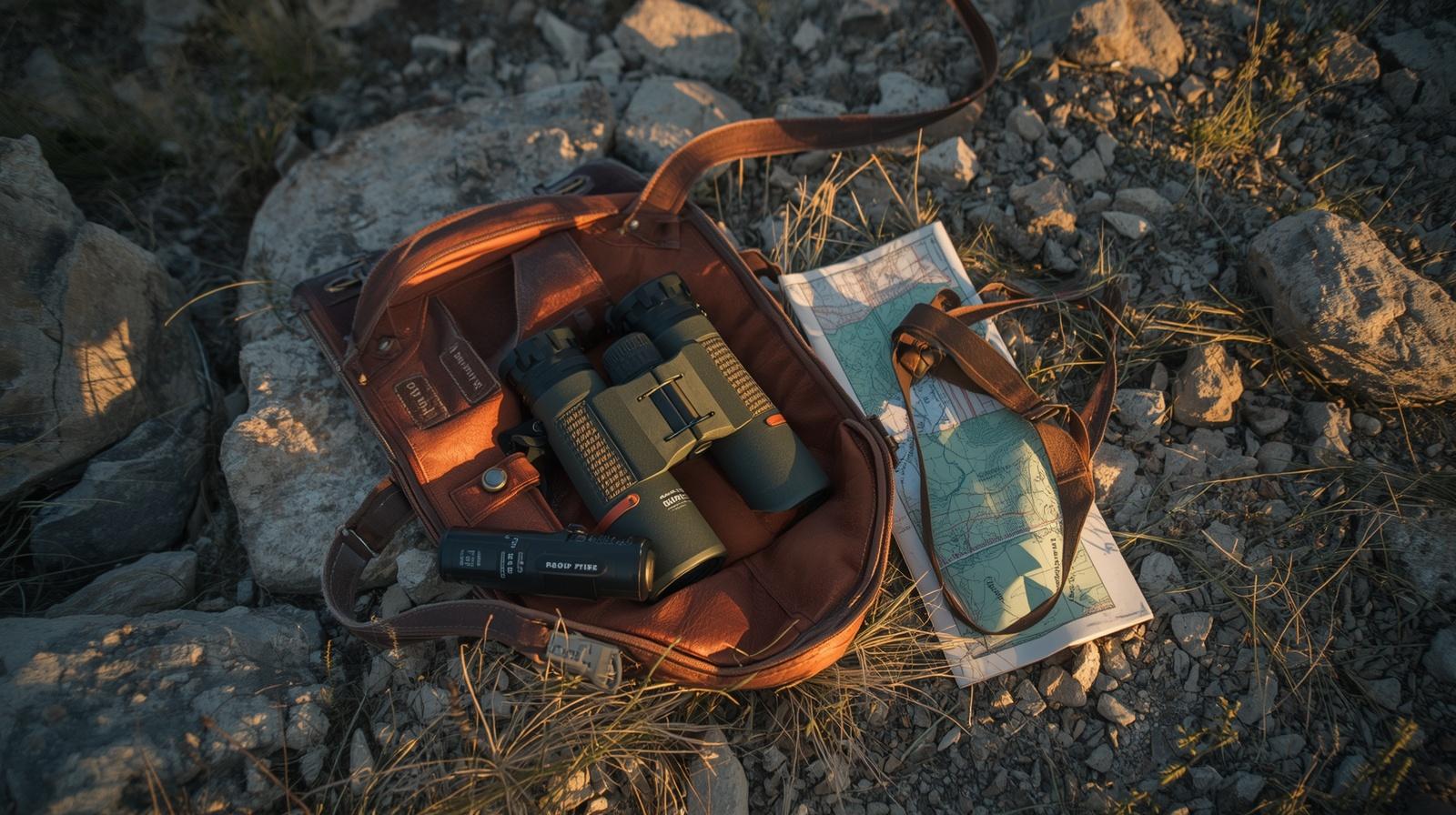
A slim roof prism binocular sits better in a bino harness. It does not snag as much. It packs easier. It handles wet weather better when properly sealed. It also feels more balanced when you are glassing one-handed or moving between locations.
For spot-and-stalk hunting, mountain hunting, western hunting, and long hiking days, roof prism binoculars are usually the better call.
This is where the porro vs roof prism binoculars for hunting decision becomes pretty clear: if you move a lot, roof prism wins.
Pros of Roof Prism Binoculars for Hunting
| Roof Prism Advantage | Real Hunting Benefit |
|---|---|
| Compact body | Easier to carry in a harness |
| Better sealing potential | More reliable in rain, fog, and dust |
| Lightweight options | Better for long hikes |
| Durable body design | Handles rough use better |
| Cleaner ergonomics | Faster handling in active hunting situations |
| Premium models are excellent | Best choice for serious hunters |
Cons of Roof Prism Binoculars for Hunting
The biggest downside is price.
Roof prism binoculars are harder to make well. Cheap roof prism models can be underwhelming because they need better coatings and phase correction to match good porro image quality.
That is why a low-budget roof prism binocular may not impress you.
A roof prism binocular has to be properly built. Look for fully multi-coated lenses, phase-corrected prisms, waterproof sealing, and a solid armor grip.
Without those features, you are just paying for a slimmer shape.
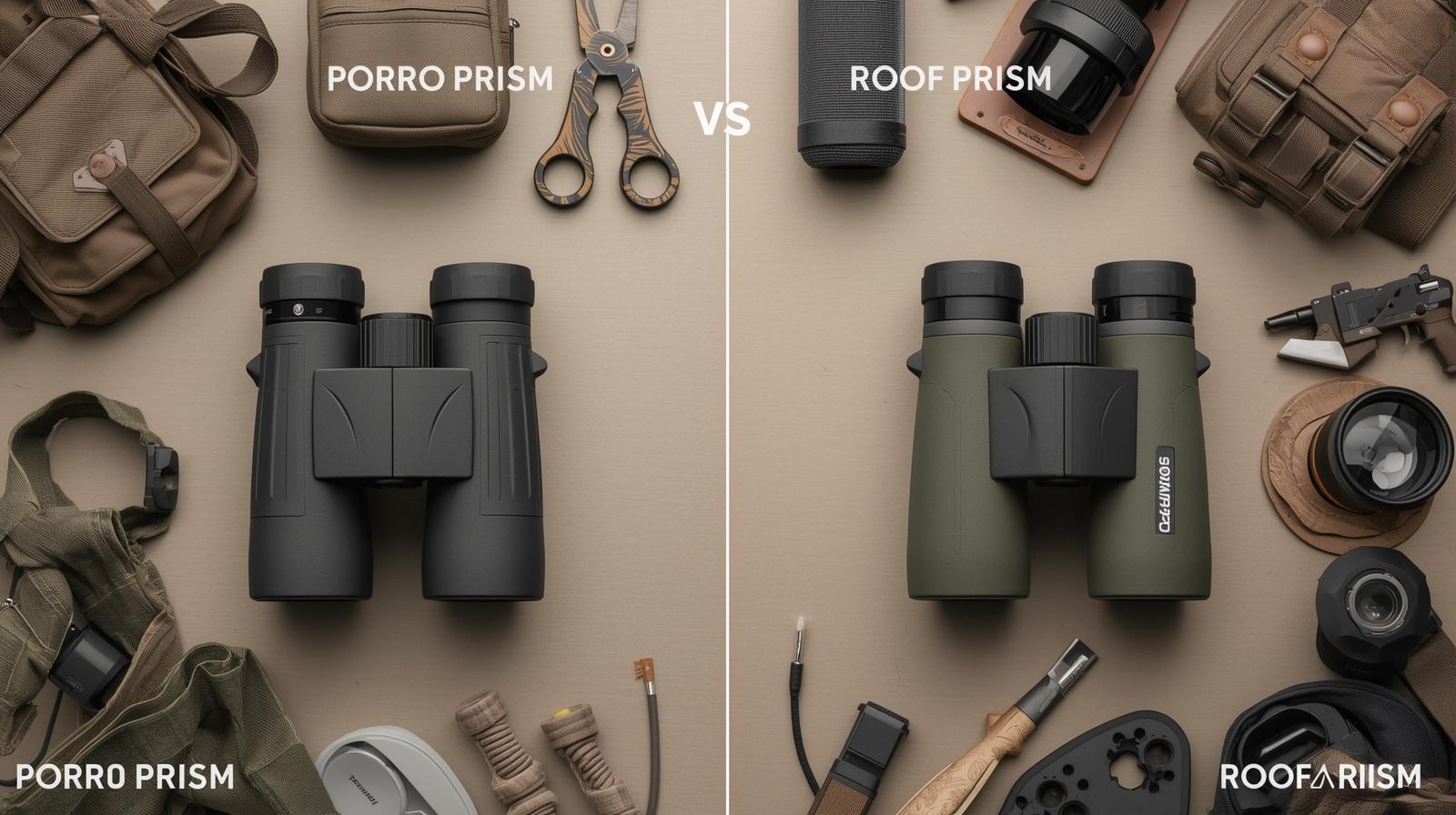
Porro vs Roof Prism Binoculars for Hunting: Side-by-Side Comparison
Here is the practical comparison most hunters actually need.
| Feature | Porro Prism Binoculars | Roof Prism Binoculars | Better Choice |
|---|---|---|---|
| Image depth | Strong 3D effect | Flatter but clean image | Porro |
| Compactness | Bulkier | Slim and packable | Roof |
| Durability | Varies by model | Usually better for field abuse | Roof |
| Waterproofing | Less common in cheap models | Common in hunting models | Roof |
| Price-to-image value | Very strong | Costs more for quality | Porro |
| Chest harness comfort | Awkward for some models | Excellent | Roof |
| Low-light value | Good for the price | Excellent in quality models | Depends on budget |
| Best for moving hunters | Not ideal | Very good | Roof |
| Best for blind hunters | Good option | Also good | Tie |
| Long-term hunting investment | Limited at budget level | Better overall | Roof |
Which Is Better for Deer Hunting?
For deer hunting, roof prism binoculars usually make more sense.
Most deer hunters spend time walking, sitting, scanning field edges, checking timber pockets, and glassing at dawn or dusk. A compact 8×42 or 10×42 roof prism binocular is easier to carry and faster to use.
If you hunt from a treestand or blind only, porro binoculars can still work well. The bigger body will not bother you much if your gear is already set up.
For thick woods, I would lean toward 8×42 roof prism binoculars. They offer a wider field of view and steadier image than 10x models. You do not need extreme magnification when visibility is limited by trees.
For open fields or longer farmland views, 10×42 roof prism binoculars make more sense.
Which Is Better for Elk and Western Hunting?
For elk, mule deer, pronghorn, and western glassing, roof prism binoculars are the obvious winner.
Not because porro glass cannot show detail.
It can.
But western hunting is physical. You are moving, climbing, glassing for long sessions, and carrying more gear. A bulky porro binocular gets old fast.
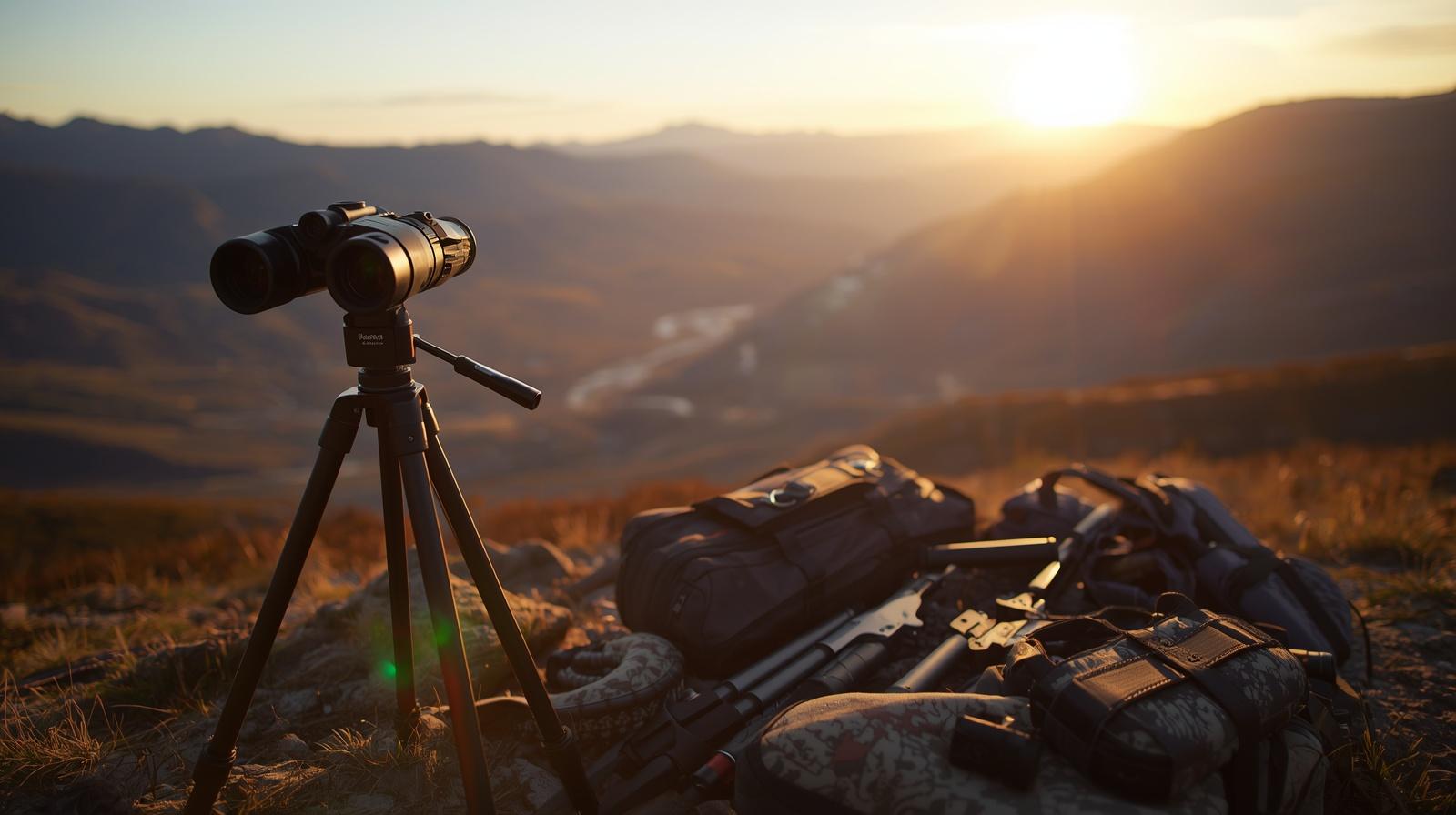
Roof prism binoculars fit the modern western hunting system better: chest harness, tripod adapter, rangefinder, pack, lightweight layers, and quick access.
If you hunt open country, a 10×42 roof prism binocular is the classic choice. Some hunters prefer 12×50, but that is harder to hold steady without support.
For most hunters, 10×42 is the sweet spot.
Which Is Better for Turkey, Hog, and Woodland Hunting?
For turkey and hog hunting, I would still choose roof prism binoculars.
These hunts often involve movement, quick setups, and changing locations. A compact binocular is easier to manage when you already have calls, seat pads, packs, decoys, or other gear.
Porro binoculars can work from a fixed blind, especially for hog hunting near feeders or field edges. But once movement is involved, roof prism binoculars feel cleaner.
A lighter 8×42 roof prism binocular is excellent for woodland use. You get a stable image, better field of view, and enough brightness for shaded areas.
Best Magnification for Hunting: 8×42 or 10×42?
This matters more than many beginners think.
A 10x binocular sounds better because it brings things closer. But higher magnification also means more shake, narrower field of view, and sometimes more eye strain.
For hunting, the safest picks are:
| Hunting Situation | Best Size |
|---|---|
| Thick woods | 8×42 |
| Treestand hunting | 8×42 or 10×42 |
| Open fields | 10×42 |
| Western hunting | 10×42 |
| Long glassing with tripod | 10×42 or 12×50 |
| Beginner hunters | 8×42 |
| All-around use | 10×42 roof prism |
For the porro vs roof prism binoculars for hunting decision, I would rather own a good 8×42 roof prism than a cheap 12×50 porro that is hard to carry and shaky in real use.
Big numbers do not always mean better hunting performance.
Recommended Product: Vortex Diamondback HD 10×42
If you want one practical recommendation, the Vortex Diamondback HD 10×42 is a strong all-around roof prism hunting binocular.
It is not the most expensive glass. It is not trying to be elite European optics. But for many hunters, it hits the useful middle ground: compact body, good field performance, 10x magnification, 42mm objective lenses, a weather-resistant hunting build, and a price point that feels realistic for regular users.
This is the kind of binocular that makes sense if you hunt deer, elk, hogs, turkey, or general mixed terrain.
Why I like it for this topic: it proves why roof prism binoculars dominate hunting. You get a slim body that fits a harness, enough power for open views, and better field convenience than most porro models.
Would a porro binocular at the same price sometimes look surprisingly bright? Yes.
Would I rather carry the Diamondback HD 10×42 all day? Also yes.
That is the practical difference.
Buyer Psychology: Why Hunters Often Choose the Wrong Binoculars
A lot of hunters buy binoculars emotionally.
They see “12x” or “20x” and think more power means better spotting. Then they get into the woods and realize the image shakes too much.
Or they buy the cheapest roof prism binocular because it looks modern, then wonder why it looks dim at sunset.
Or they buy a bulky porro binocular because it looked sharp in the store, then stop carrying it because it does not fit their harness.
This is the real buying trap.
The best hunting binocular is not always the one with the sharpest image indoors. It is the one you actually keep on your chest and use constantly.
For most hunters, that means roof prism.
For careful budget buyers, porro still deserves attention. If you are curious about whether porro designs can beat roof prism models in some cases, read this supporting guide: are porro prism binoculars better. It explains where porro optics still have a legit advantage.
Common Mistakes When Choosing Hunting Binoculars
Mistake 1: Buying Too Much Magnification
More magnification is not always better.
A 10x binocular is useful, but 12x or 15x can be hard to hold steady. Unless you use a tripod, too much magnification may make your view worse, not better.
Mistake 2: Ignoring Weight
A heavy binocular feels fine for five minutes.
After six hours, it becomes annoying.
If you walk a lot, choose roof prism binoculars with a compact body and comfortable harness fit.
Mistake 3: Choosing Cheap Roof Prism Glass Without Checking Coatings
Roof prism binoculars need quality coatings to perform well. Look for phase correction, fully multi-coated optics, and decent low-light performance.
A cheap roof prism model can lose to a good porro.
Mistake 4: Thinking Porro Binoculars Are Outdated
Porro binoculars are not useless. They are just less convenient for modern hunting. If your style is stationary and budget-focused, they can still be a smart buy.
Mistake 5: Forgetting Eye Relief
If you wear glasses, eye relief matters. Look for comfortable eye cups and enough eye relief so you can see the full image without fighting the binocular.
Real-World Use Cases
Use Case 1: Budget Deer Hunter in a Treestand
A hunter sitting in a treestand over a field edge does not need ultra-premium roof prism glass.
A decent porro prism binocular can work well here because movement is limited. The wider body is not a huge problem, and the image depth can help when scanning brush lines.
Best pick: 8×42 porro or affordable 8×42 roof prism
Use Case 2: Mobile Public Land Hunter
A public land hunter moving through timber needs compact gear.
This is where roof prism binoculars make life easier. They sit better in a harness, handle wet weather better, and stay out of the way while hiking.
Best pick: 8×42 roof prism
Use Case 3: Western Spot-and-Stalk Hunter
For open-country hunting, roof prism binoculars are usually the stronger choice.
You need portability, durability, and enough magnification to scan distant terrain. A 10×42 roof prism binocular is the most balanced option.
Best pick: 10×42 roof prism
Use Case 4: Farm and Truck Scouting
If you mostly glass from a vehicle, fence line, or fixed overlook, porro binoculars can be a smart budget choice.
Bulk does not matter as much. Image quality per dollar matters more.
Best pick: 10×50 porro or 10×42 roof prism
Final Verdict: Porro vs Roof Prism Binoculars for Hunting
For most hunters, roof prism binoculars are better for hunting because they are compact, durable, weather-ready, and easier to carry all day.
That is the no-fluff answer.
But porro prism binoculars are still useful in the right hunting situations.. They still offer strong optical value, especially for hunters who sit in blinds, glass from fixed locations, or want better image quality on a tight budget.
Here is the simplest way to choose:
| Choose Porro Prism If… | Choose Roof Prism If… |
|---|---|
| You hunt mostly from a fixed spot | You walk, hike, or stalk often |
| Your budget is tight | You want long-term durability |
| You care about depth perception | You need compact gear |
| You do not use a chest harness much | You use a bino harness |
| You want value over portability | You want the most practical hunting setup |
My honest recommendation: if you are buying one serious hunting binocular, choose a roof prism 8×42 or 10×42.
If you are building a budget setup or need a backup pair for blind hunting, a porro prism binocular is still worth considering.
For more related optics comparisons and field-buying advice, visit the main site here: Best Binocular. You can also check the blog tips page for more practical binocular buying tips before choosing your next pair.
FAQs About Porro vs Roof Prism Binoculars for Hunting
Are porro or roof prism binoculars better for hunting?
Roof prism binoculars are better for most hunting because they are compact, durable, and easier to carry in the field. Porro prism binoculars can still be good for fixed-position hunting and budget buyers.
Are porro prism binoculars good for deer hunting?
Yes, porro prism binoculars can be good for deer hunting, especially from blinds, treestands, and field edges. However, roof prism binoculars are usually better if you move a lot or need a compact setup.
Why do most hunters use roof prism binoculars?
Most hunters use roof prism binoculars because they fit better in chest harnesses, handle rough weather better, and have a slimmer body. They are more practical for active hunting.
Do porro binoculars have better image quality?
At the same budget level, porro binoculars can sometimes offer better brightness and depth perception. However, high-quality roof prism binoculars can deliver excellent sharpness, contrast, and low-light performance.
What size binoculars are best for hunting?
The best all-around hunting binocular sizes are 8×42 and 10×42. Choose 8×42 for woods and close-range hunting. Choose 10×42 for open fields, western hunting, and longer glassing distances.
Are 10×42 binoculars good for hunting?
Yes, 10×42 binoculars are one of the most popular hunting choices. They offer a strong balance of magnification, brightness, portability, and field usability.
Should beginners choose porro or roof prism binoculars?
Beginners should usually choose roof prism binoculars if the budget allows. They are easier to carry and more versatile. Budget beginners who hunt from fixed positions can still consider porro prism binoculars.




