
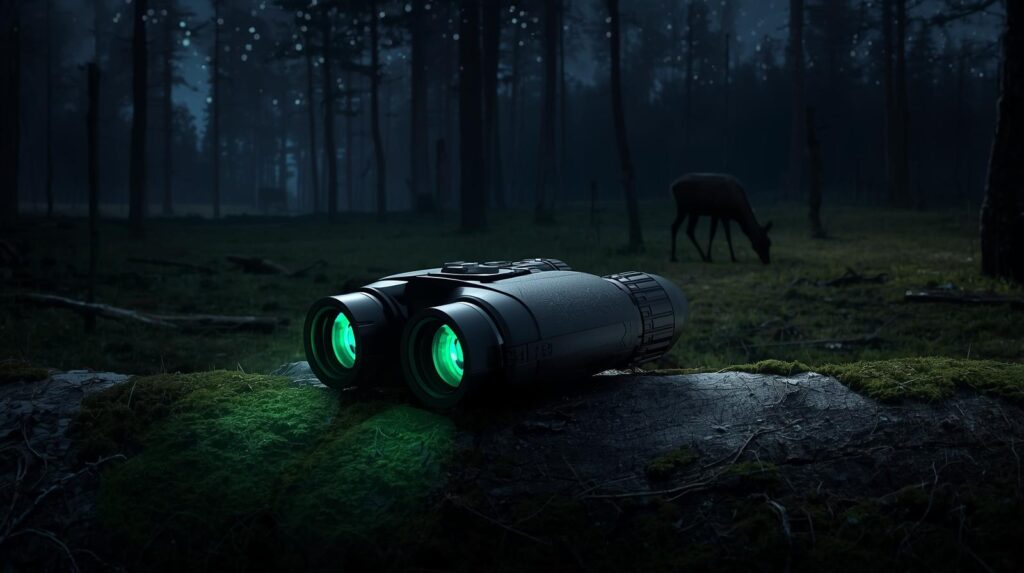
Best Night Vision Binoculars for Wildlife Observation in 2026 should help you see clearly after dark without making nighttime viewing feel complicated. Good night vision optics should offer useful infrared performance, comfortable viewing, practical controls, and enough detail to identify animals from a safe distance.
For wildlife enthusiasts, nighttime opens a completely different side of nature.
Deer often move more confidently after sunset. Foxes, raccoons, owls, and other nocturnal animals become active when daylight fades. Standard binoculars can still help in low light, but once the environment becomes genuinely dark, they quickly reach their limits.
Digital night vision solves that problem.
These devices use an electronic sensor and display to create a visible image in darkness. When natural light is not enough, an infrared illuminator helps the sensor reveal animals and surrounding terrain.
For this guide, we are focusing on one practical option rather than comparing a long list of nearly identical products: the CREATIVE XP Pro Night Vision Binoculars.
Its large viewing screen, infrared capability, photo and video recording, and straightforward controls make it especially interesting for backyard wildlife watching, camping, rural observation, and nighttime nature viewing.
Why Night Vision Is Useful for Wildlife Observation
Many animals behave differently after dark.
A field that seems empty during the afternoon may become active after sunset. Woodland edges can suddenly reveal deer, foxes, rabbits, raccoons, and other animals moving between feeding and resting areas.
Using a bright flashlight can immediately change that experience.
Visible light may draw attention to your position or cause an animal to change direction. Night vision lets you observe dark areas without relying on a powerful white beam.
That makes it useful for:
- Nocturnal wildlife observation
- Backyard animal watching
- Camping
- Rural property monitoring
- Night nature walks
- Watching animals from a blind or fixed position
- Recording nighttime wildlife behavior
The biggest advantage is not simply seeing farther.
It is being able to observe animals that would otherwise disappear into darkness.
How Digital Night Vision Binoculars Work
Most consumer night vision binoculars now use digital technology.
They work differently from ordinary optical binoculars.
Instead of sending light directly through the lenses to your eyes, a digital night vision device captures the scene with an electronic sensor. That information is processed and displayed on a screen.
When some moonlight, starlight, or nearby artificial light is available, the sensor may already produce a usable image.
When the surroundings become much darker, the infrared illuminator provides extra illumination for the sensor.
You then see the processed image on the display.
This is what allows digital night vision binoculars to remain useful when normal binoculars become too dark to provide meaningful detail.
What Is 850nm Infrared?
The CREATIVE XP Pro uses infrared illumination intended for nighttime viewing.
Infrared light operates outside the normal visible spectrum used by human eyesight, which is why it can illuminate a scene for the digital sensor without working like a conventional flashlight.
However, infrared should not be treated as a way to become completely invisible to wildlife.
Some IR emitters may show a faint red glow at the source, and animals can still notice your movement, scent, sound, or presence.
For wildlife observation, the best approach is still simple: stay quiet, keep your distance, and avoid disturbing the animal.
CREATIVE XP Pro Night Vision Binoculars Review
The CREATIVE XP Pro Night Vision Binoculars are designed around relaxed digital viewing rather than a compact tactical-style setup.
One of the most noticeable features is the large display.
Instead of pressing a small eyepiece tightly against your face, you can view the nighttime scene on a 4-inch screen.
That design makes the device particularly suitable for stationary wildlife observation.
If you are sitting beside a campsite, watching a field edge, or checking a backyard after dark, a larger display can feel more comfortable than repeatedly looking through a narrow eyepiece.
The device also supports photo and video recording, which adds another useful dimension for wildlife watchers.
You can observe an animal in the moment and save the encounter for later.
Large Screen for Comfortable Viewing
A large screen may not sound like an important feature until you spend a long time observing wildlife.
With a small eyepiece, you normally need to hold the device directly against your face.
A larger display gives you more freedom.
You can raise the unit, scan an area, lower it, and repeat the process without feeling locked into the viewing position.
It also makes it easier to share the view with someone standing beside you.
That can be useful for couples, families, beginner wildlife watchers, and anyone observing from a fixed location.
For long-distance hiking, the larger body may be less convenient than a compact monocular.
For patient wildlife observation, however, the larger screen can be a genuine advantage.
Performance in Complete Darkness
Night vision becomes most valuable when natural light is extremely limited.
A clear night with moonlight may already provide enough ambient light for a digital sensor to produce a usable image.
A moonless forest is different.
In those conditions, the infrared illuminator becomes essential.
The IR light reflects from animals, trees, grass, and other objects before returning to the night vision sensor.
The device processes that information and creates a visible image on the screen.
This makes the CREATIVE XP Pro useful in places such as:
- Dark woodland
- Open fields
- Campsites
- Rural properties
- Backyards
- Farm areas
- Forest edges
The important thing is to keep expectations realistic.
Digital night vision does not turn darkness into the same rich, colorful image you would see through premium daytime binoculars.
The image is electronic.
Fine details can change depending on distance, focus, vegetation, infrared strength, and zoom level.
The value comes from being able to observe a scene that would otherwise be almost impossible to see.
Why Digital Zoom Should Not Be the Main Buying Factor
Large zoom numbers are often used to market digital night vision products.
They can be misleading.
Optical magnification and digital zoom are not the same thing.
Optical magnification enlarges the subject through the lens system before the sensor captures the image.
Digital zoom enlarges an image that has already been captured.
As digital zoom increases, the animal appears larger on the screen, but image quality can become softer.
That means more zoom does not always mean more useful detail.
For wildlife observation, moderate magnification is often easier to use.
A wider view helps you locate an animal quickly.
Once the animal is centered, you can increase digital zoom slightly if needed.
This usually produces a better viewing experience than constantly using maximum zoom.
Recording Photos and Videos at Night
Digital night vision has one major advantage over ordinary binoculars: it can record what you see.
The CREATIVE XP Pro supports both photo and video capture.
For wildlife watchers, this is more useful than it may initially sound.
A short nighttime sighting can be difficult to remember accurately.
You may see an animal for ten seconds and later wonder about its size, markings, movement, or behavior.
Recording the encounter allows you to review those details later.
You might capture:
- Deer crossing a field
- Foxes moving through a yard
- Raccoons around a feeder
- Owls near a familiar habitat
- Small mammals around a campsite
- Unusual nocturnal behavior
Recording is also useful for wildlife content creators.
The image quality will not replace a dedicated professional camera setup, but built-in recording makes it much easier to document unexpected encounters.
Is the CREATIVE XP Pro Good for Owl Watching?
It can be a useful tool for nighttime bird observation, especially when searching for owls and other nocturnal species.
Owls often remain motionless for long periods, making them difficult to locate with the naked eye once daylight disappears.
Night vision can help you scan likely perches and woodland edges without relying entirely on visible light.
That said, responsible observation matters.
Avoid moving closer simply because the owl remains still.
Do not repeatedly approach roosting or nesting birds.
Keep voices low and movement controlled.
The aim is to observe natural behavior, not force the bird to react.
For normal daytime birding, standard optical binoculars remain the better choice because they provide natural color, stronger optical clarity, and a more direct viewing experience.
Night vision should be treated as a separate tool for after-dark observation.
If you also need traditional daytime optics, our Bushnell binocular guides cover models designed for birding, wildlife, travel, and general outdoor use.
Detection Range and Identification Range Are Different
When shopping for night vision binoculars, it is easy to focus on maximum advertised distance.
That number does not always tell the full story.
There is a difference between seeing movement and identifying an animal clearly.
At one distance, you may notice that something is moving.
Closer in, you may recognize that it is a deer.
Closer still, you may be able to see body shape, antlers, facial detail, or other identifying features.
Those are different levels of performance.
Animal size also matters.
A deer standing in an open field is much easier to detect than a small owl hidden among branches.
Vegetation can reduce usable range as well.
Nearby grass, leaves, or branches may reflect infrared light strongly and make distant objects harder to see.
That is why practical viewing distance matters more than an impressive maximum-range claim.
Battery Life and IR Settings
Night vision binoculars use more power than ordinary optics.
The screen, sensor, processor, recording system, and infrared illuminator all require energy.
The IR illuminator can consume a significant amount of battery power, especially at stronger settings.
For short sessions, this may not matter.
For longer wildlife observation, it becomes important.
A useful habit is to start with a low IR setting.
Increase the level only when the image genuinely needs more illumination.
This can help:
- Extend battery life
- Reduce glare
- Prevent nearby vegetation from becoming overly bright
- Improve the balance of the image at shorter distances
If you regularly spend several hours outside, keeping backup power available is also sensible.
You can explore cases, straps, cleaning kits, and other useful equipment in our binocular accessories section.
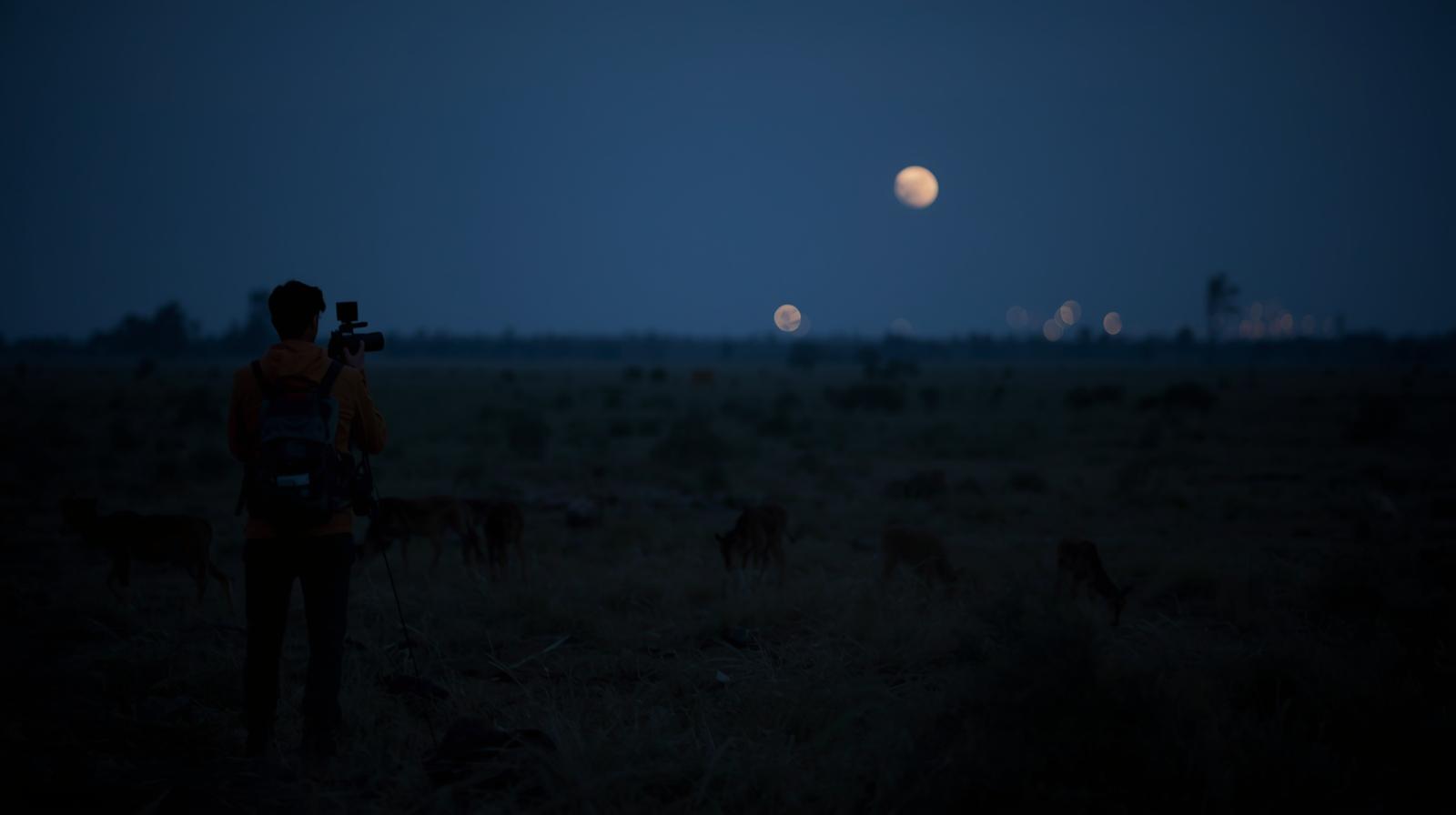
Handheld Use vs Tripod Use
The CREATIVE XP Pro can be used by hand, but longer sessions can eventually become tiring.
Any electronic viewing device held in front of your body for a long period will create arm fatigue.
For quick scanning, handheld use is convenient.
For watching one area for an extended period, a stable support can improve the experience.
A tripod can help by providing:
- A steadier image
- Smoother video recording
- Easier long-term observation
- Less arm fatigue
- More consistent framing
This is particularly useful if you regularly watch the same field, feeding area, or woodland edge.
A steady image can also make subtle animal movement easier to notice.
For stationary wildlife observation, stability often matters more than adding extra digital zoom.
Who Is the CREATIVE XP Pro Best For?
The CREATIVE XP Pro makes the most sense for users who want straightforward night vision with a large screen and recording capability.
Backyard Wildlife Watchers
If animals regularly visit your yard after dark, this type of device can make nighttime observation much easier.
The larger screen works particularly well when you are sitting on a porch, deck, or near a window.
Campers
Night vision allows you to check nearby activity without constantly turning on a bright flashlight.
It should still be used alongside a proper flashlight or headlamp for safe navigation.
Wildlife Enthusiasts
If you enjoy observing animal behavior, night vision opens hours of activity that ordinary binoculars cannot show.
Rural Property Owners
The device can be useful for identifying animals moving near fields, fences, barns, or other parts of a rural property.
Wildlife Content Creators
Built-in recording allows you to save nighttime encounters without immediately reaching for another camera.
Who Should Consider a Different Device?
The CREATIVE XP Pro is not ideal for every situation.
Long-Distance Hikers
If you are carrying equipment for many miles, a compact night vision monocular may be easier to pack.
If portability matters most, you can also explore our compact binocular buying guides for lightweight options suited to hiking, travel, and everyday outdoor use.
Hands-Free Users
A head-mounted night vision system is more suitable if your priority is moving around while keeping your hands free.
Long-Range Specialists
Users who consistently observe animals at very long distances may benefit from a more advanced system with stronger optical magnification and higher-end imaging hardware.
Users Focused on Detection
If your main goal is finding hidden warm animals rather than seeing a natural-looking scene, thermal imaging may be more appropriate.
Digital Night Vision vs Thermal Imaging
Night vision and thermal imaging are often compared, but they do different jobs.
Digital Night Vision
Digital night vision creates an image based on available light and infrared illumination.
It is useful for seeing recognizable detail in both the animal and surrounding environment.
You can often make out:
- Body shape
- Fur or feather patterns
- Trees
- Fences
- Ground
- Vegetation
- Other objects in the scene
This makes night vision helpful for visual identification.
Thermal Imaging
Thermal imaging detects heat differences.
A warm animal can stand out clearly against a cooler background.
This makes thermal excellent for locating animals that may be difficult to notice visually.
However, the resulting image does not always provide the same natural visual detail as night vision.
A simple way to remember the difference is:
Thermal is excellent for finding animals. Night vision is better for seeing the scene around them.
For casual wildlife observation, digital night vision is usually the more familiar and approachable option.
How to Choose Night Vision Binoculars for Wildlife
The best model depends on where and how you plan to use it.
Consider Your Typical Viewing Distance
A backyard may only require short-range viewing.
An open field may require considerably more distance.
Choose magnification and IR performance according to the environment rather than simply selecting the highest numbers available.
Look at Screen Size
A larger screen is comfortable for stationary observation.
A compact eyepiece display is easier to carry.
Choose based on how much time you expect to spend walking versus watching.
Check Infrared Adjustment
Adjustable IR levels are useful because maximum illumination is not always necessary.
Being able to reduce IR can improve short-range viewing and conserve battery power.
Decide Whether Recording Matters
If you want to save wildlife encounters, look for photo and video recording support.
Also check memory-card compatibility and how easily files can be transferred.
Think About Weight
Electronic night vision is generally heavier than standard binoculars.
If you expect long sessions, consider how the device will be supported.
Check Weather Protection
Do not assume every night vision binocular is fully waterproof.
Electronic devices contain screens, ports, batteries, and other components.
Always check the manufacturer’s actual weather-resistance rating before using the device in rain or very wet conditions.
For more comparisons, reviews, and practical binocular buying advice, explore the latest guides on BestBinocular.net.
How to Observe Wildlife Responsibly at Night
Night vision makes it easier to see animals, but that does not mean you should get closer to them.
Keep a sensible distance.
Avoid blocking natural routes.
Do not chase an animal for a better recording.
Keep noise low.
Avoid repeatedly visiting sensitive nesting, roosting, or denning areas.
Use only as much infrared illumination as needed.
Most importantly, pay attention to the animal’s behavior.
If it changes direction, becomes alert, stops feeding, or repeatedly watches you, give it more space.
The best nighttime observations are usually the ones where the animal continues behaving naturally.
Common Mistakes to Avoid
Using Maximum IR Immediately
High IR settings can create excessive reflection from nearby vegetation.
Start lower and increase only when necessary.
Depending Too Much on Digital Zoom
Digital zoom can enlarge the subject while reducing image quality.
Use it moderately.
Walking While Watching a Magnified Screen
Night vision binoculars are observation tools, not substitutes for normal trail awareness.
Use proper lighting when navigating uneven terrain.
Expecting Daytime Image Quality
Night vision is designed to make darkness usable.
It will not always match the color, sharpness, or depth of good daytime optics.
Forgetting to Adjust Focus
A soft image may simply be out of focus.
Check focus before assuming the problem is with infrared strength or sensor quality.
How to Care for Night Vision Binoculars
Digital night vision contains electronics as well as optics, so proper storage matters.
Remove loose dust before wiping the lens.
Use an appropriate microfiber cloth when cleaning glass.
Keep charging and memory-card ports clean.
Let the device dry after damp outdoor use.
Use a protective case during transportation.
Avoid leaving the unit inside an extremely hot vehicle for long periods.
If you plan to store it for several months, follow the manufacturer’s recommendations for battery care.
A little routine maintenance can help preserve both optical clarity and electronic reliability.
Is the CREATIVE XP Pro Worth Buying in 2026?
For wildlife watchers who want digital night vision with a large viewing screen and recording capability, the CREATIVE XP Pro remains a practical option in 2026.
Its biggest strength is ease of use.
The large display is comfortable for stationary viewing, while infrared illumination allows you to observe wildlife after ordinary binoculars become ineffective.
Built-in photo and video recording also makes the device more useful for people who want to document encounters rather than simply watch them.
There are compromises.
It is bulkier than a compact monocular.
Digital zoom cannot replace genuine optical detail.
And the screen-based design is better suited to observation than hands-free movement.
For backyard wildlife, campsites, rural properties, field edges, and patient nighttime viewing, however, those trade-offs are reasonable.
Final Verdict
The best night vision binoculars for wildlife observation in 2026 should make nighttime viewing easier, not more complicated.
That means useful infrared performance, comfortable viewing, manageable controls, realistic magnification, and enough clarity to recognize the animals you are watching.
The CREATIVE XP Pro Night Vision Binoculars offer a balanced package for users who prioritize observation and recording.
The large screen is particularly useful for backyard wildlife watching, camping, and stationary viewing. Infrared illumination extends usability into very dark conditions, while built-in photo and video capture lets you keep a record of unusual sightings.
It will not be the perfect choice for everyone.
A compact monocular is better for ultralight travel.
Head-mounted night vision is better for hands-free movement.
Thermal imaging is better when detecting hidden animals is the main goal.
But for someone who wants a straightforward way to explore wildlife after sunset, the CREATIVE XP Pro offers a practical and approachable starting point.
Ready to Explore Wildlife After Dark?
👉 Shop the Best Night Vision Binoculars on Amazon
Unlock the hidden world of nocturnal wildlife.
Frequently Asked Questions
Do night vision binoculars work in complete darkness?
Yes, digital night vision binoculars with an infrared illuminator can work when visible ambient light is extremely limited. The IR system provides illumination that the sensor converts into an image on the screen.
Are night vision binoculars good for wildlife observation?
Yes. They are especially useful for nocturnal wildlife such as deer, foxes, raccoons, owls, and other animals that become active after sunset.
Can animals see infrared light?
Infrared light used by night vision falls outside normal human-visible wavelengths, but you should not assume wildlife cannot detect your presence. Animals may still notice movement, scent, sound, or a faint glow from some IR emitters.
Is 850nm infrared suitable for wildlife viewing?
Yes. 850nm IR is commonly used in digital night vision because sensors can detect it effectively in dark conditions. Some emitters may produce a faint red glow at the source.
Is thermal better than night vision for wildlife?
Thermal imaging is better for detecting warm animals, while night vision usually provides more recognizable detail about the animal and surrounding environment.
Can night vision binoculars record video?
Many digital models can. The CREATIVE XP Pro includes photo and video recording capability.
Can digital night vision be used during the day?
Many digital night vision devices can also operate in daylight, but you should always follow the instructions for the specific model you own.
Are night vision binoculars useful for owl watching?
Yes, particularly for locating and observing owls after dark. Keep a respectful distance and avoid disturbing roosting or nesting birds.
Is more magnification better for nighttime wildlife?
Not always. Moderate magnification makes animals easier to locate and keeps the field of view wider. Very high digital zoom can make the image softer.
Should I buy night vision binoculars or a monocular?
Choose binocular-style digital night vision if comfortable viewing and a larger display matter most. A monocular is generally better when compact size and low weight are priorities.




